 Built In Oasis


AI Role Redundancy Analyzer
Functional DemoAn AI-assisted labor capacity simulator that models the workforce needed to hit a production goal.
A probabilistic financial simulation engine that models the profit and risk of an event before it happens.
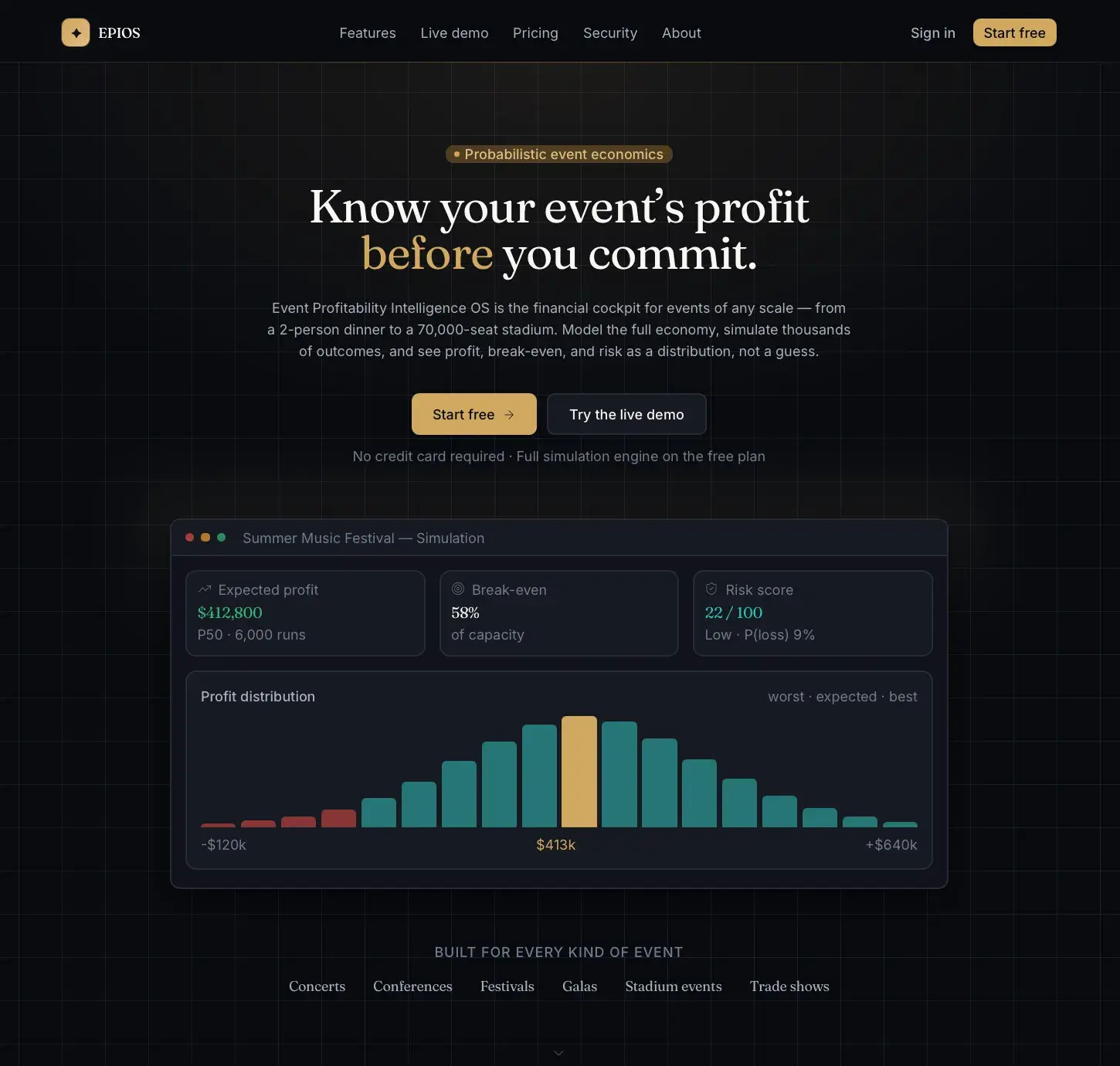
Deciding whether an event will make money usually means building a spreadsheet by hand, entering dozens of cost and revenue assumptions, and still getting a single guessed number that ignores uncertainty. Event costs and revenues scale non-linearly with venue size and attendance, so linear estimates mislead. Organizers have no easy way to see the full range of outcomes, the break-even point, or the probability of a loss before committing money.
Built for Event organizers and planners evaluating the financial viability of physical and hybrid events.
The Event Profitability Engine turns three simple inputs — event type, venue scale, and monetization strategy — into a full synthetic model of an event's economy. It infers attendance ranges, ticket pricing, revenue streams, and cost tiers, then runs Monte Carlo-style scenario sampling to produce probability distributions for revenue, cost, profit, and ROI rather than single point estimates. It models multi-stream revenue (tickets, VIP, sponsorships, vendors, merchandise, concessions, digital and affiliate) with saturation and elasticity curves, and non-linear cost scaling with step-function jumps. Interactive what-if controls recalculate profit curves, break-even, and risk as variables change, and a strategy layer converts results into pricing, venue, and risk-mitigation recommendations.
The core engineering is a probabilistic simulation engine built from scratch: non-linear cost and revenue models with saturation and elasticity curves, occupancy and demand modeling, and Monte Carlo-style scenario sampling that outputs distributions with confidence intervals and probability of loss. It shows an inference layer that generates a complete event economy from minimal inputs, plus a pluggable server-side AI advisor that runs in a deterministic grounded mode with no key and enhances narrative when a provider key is present.
Most event tools plan, budget, and ticket. This one simulates the entire financial outcome space of an event before it is ever executed.
Input Abstraction Layer
Reduces every event to three inputs: event type, venue scale, and monetization strategy.
Event Inference Engine
Converts the three inputs into a full synthetic event economy model — attendance, pricing, cost structure, revenue streams, complexity, and risk.
Revenue System Engine
Models multi-stream revenue (tickets, VIP, sponsorship, vendors, merchandise, concessions, streaming) with saturation and diminishing-returns curves.
Cost Model Engine
Models fixed, variable, and scaling costs as piecewise nonlinear functions rather than linear multipliers.
Occupancy + Demand Engine
Maps attendance behavior under uncertainty across failure, break-even, profit, and saturation zones.
Profit Simulation Engine
Runs Monte Carlo-style scenario sampling to produce revenue, cost, profit, break-even, and ROI distributions.
Scenario Intelligence EngineWhat-If
Recalculates profit curve, break-even, and risk instantly as variables like price, attendance, and sponsorship are changed.
Event Design Optimization Engine
Turns layout into a revenue problem — seating, pricing zones, VIP allocation, and stage-placement impact.
Risk Modeling Engine
Simulates failure conditions and outputs risk score, failure probability, downside exposure, and volatility index.
AI Strategy Engine
Converts simulation outputs into pricing, venue-size, monetization-mix, and risk-mitigation recommendations.
Risk profile
Exposure to weather-driven attendance and logistics failure.
Demand shortfall relative to break-even occupancy.
Vendor non-participation or withdrawal impact.
Under-staffing against nonlinear headcount needs.
Infrastructure and logistics clustering failures.
Loss of sponsorship revenue the model depends on.
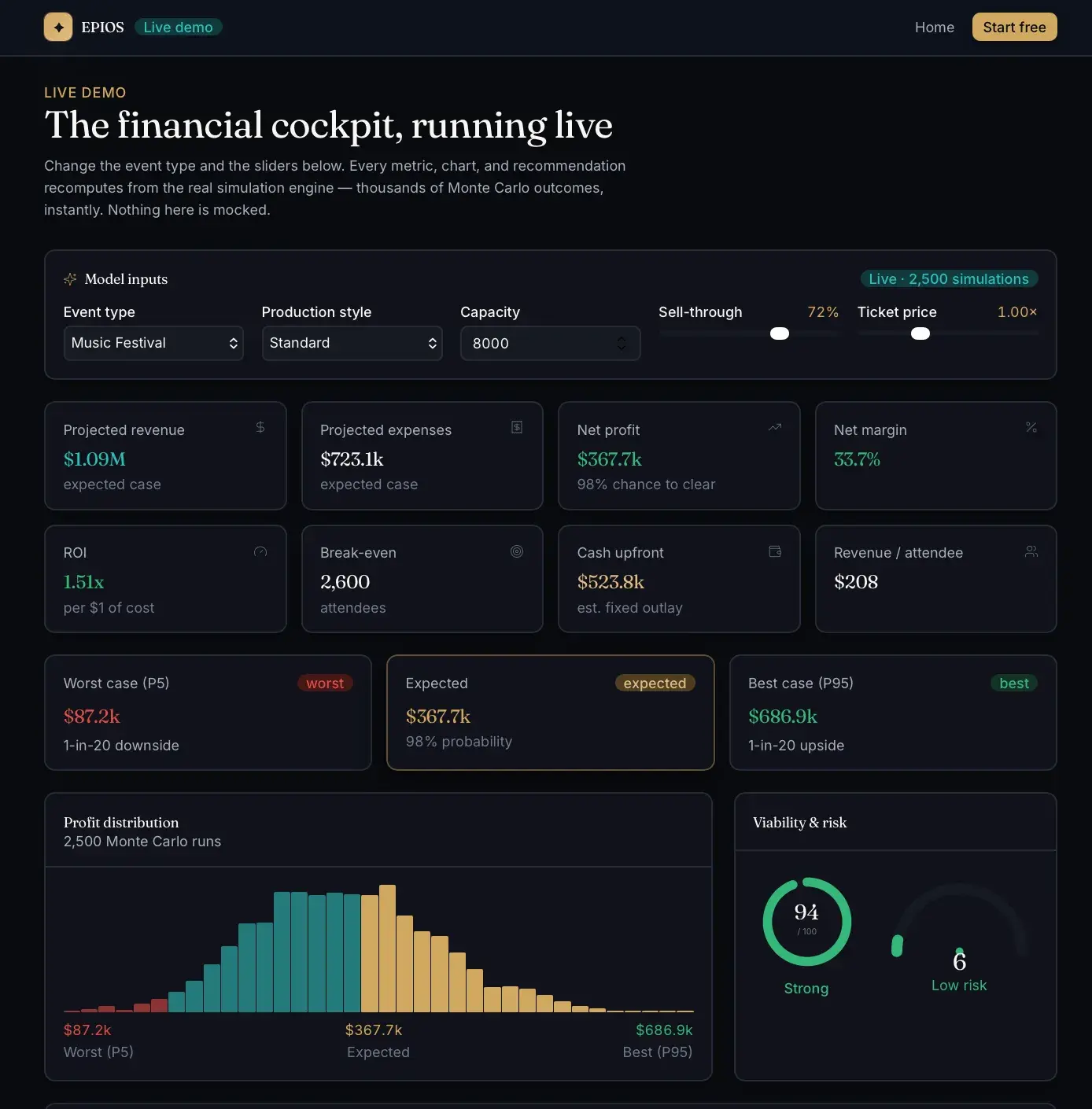
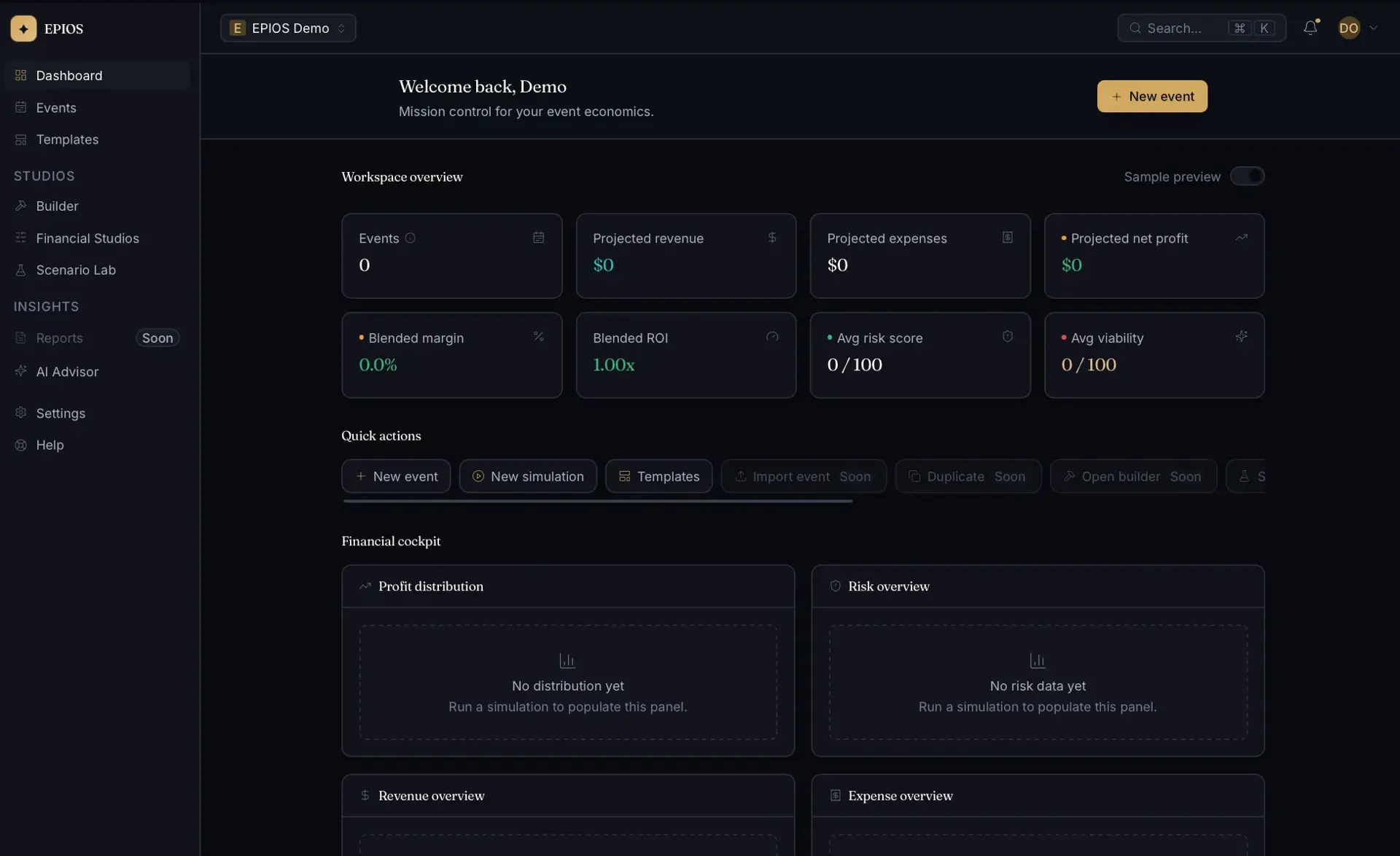
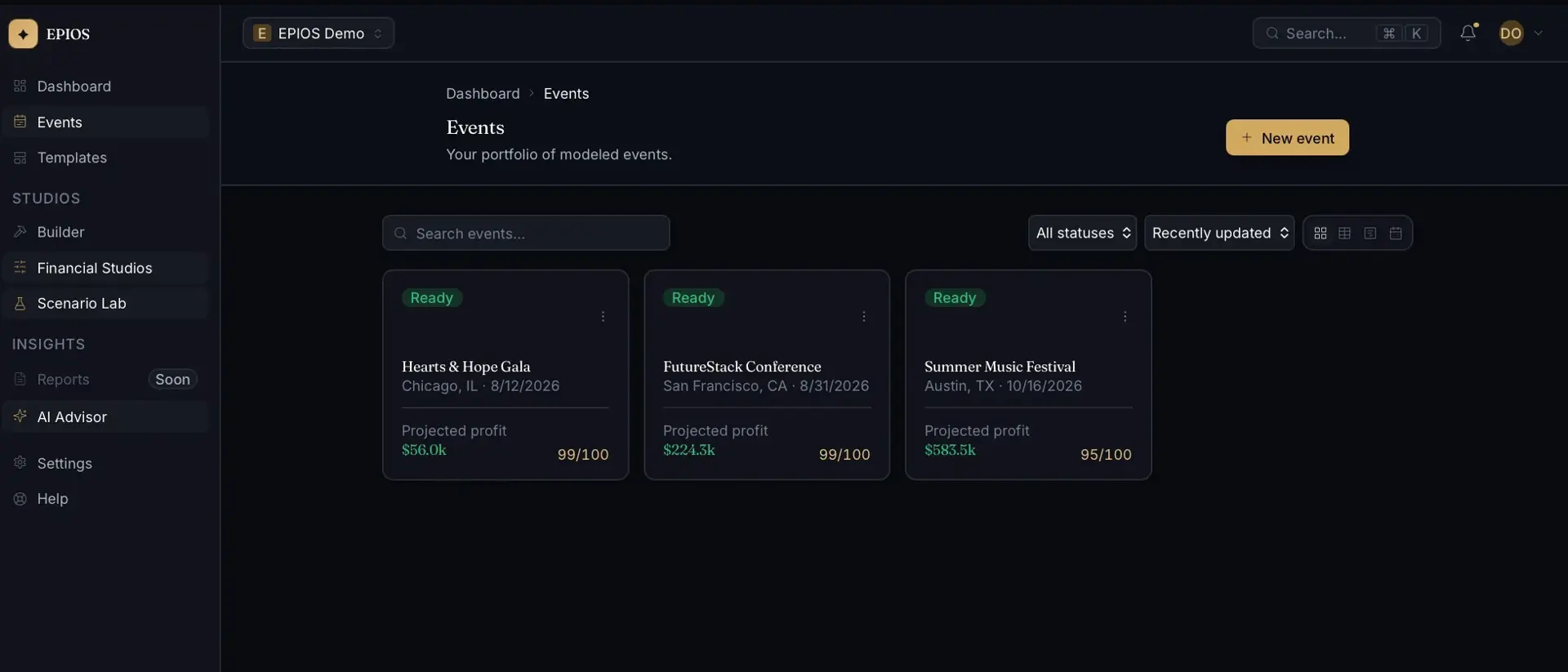
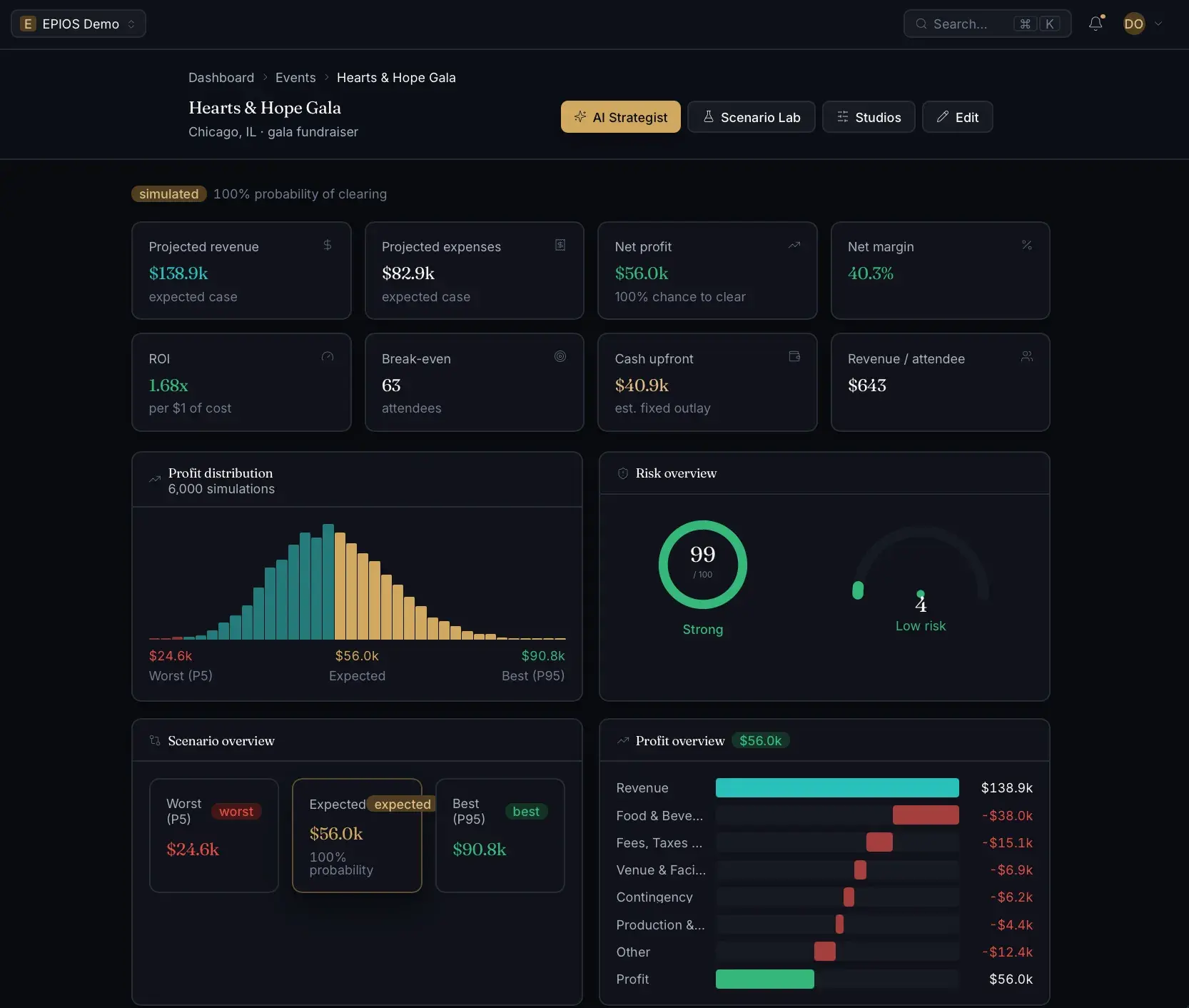
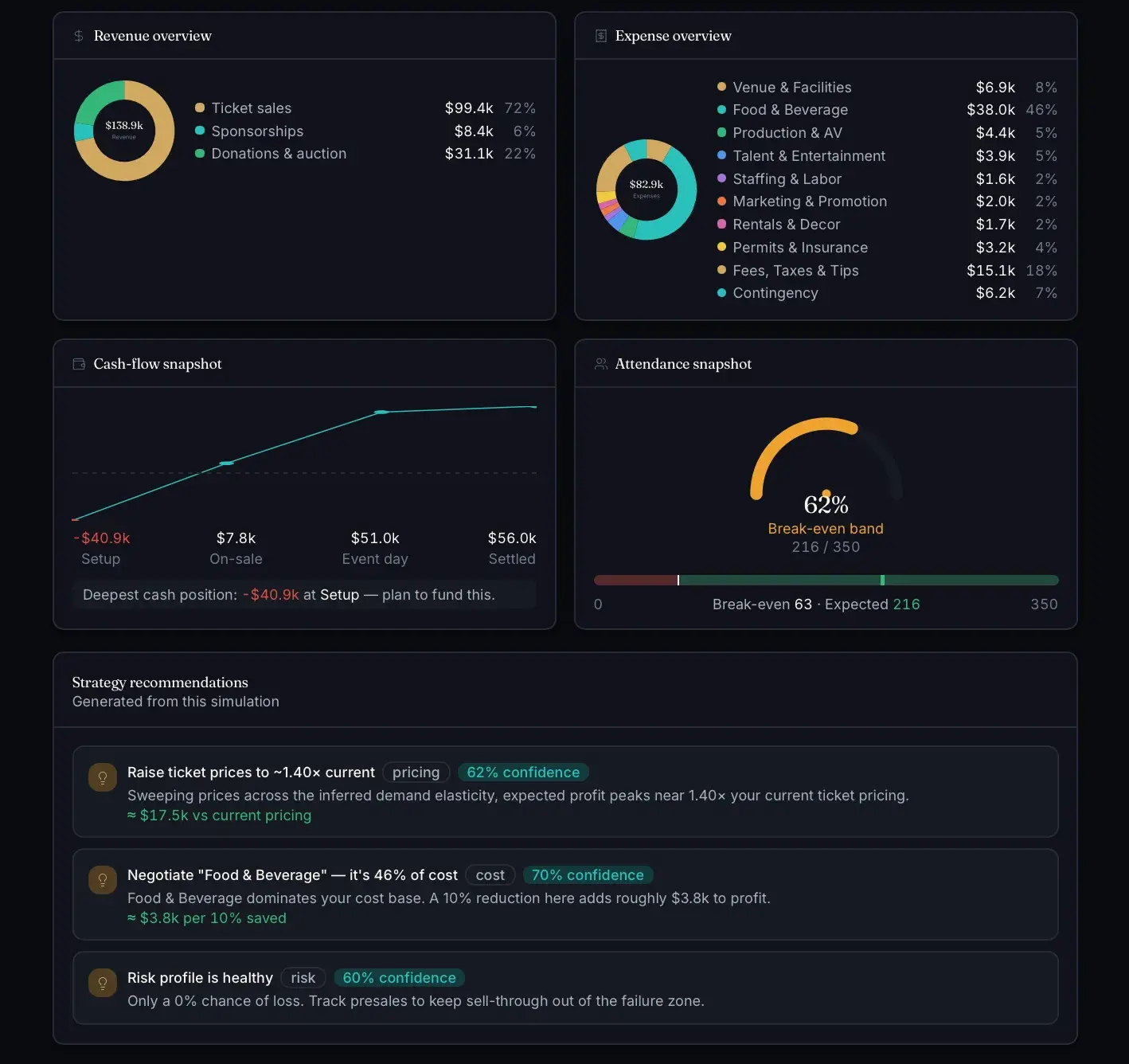
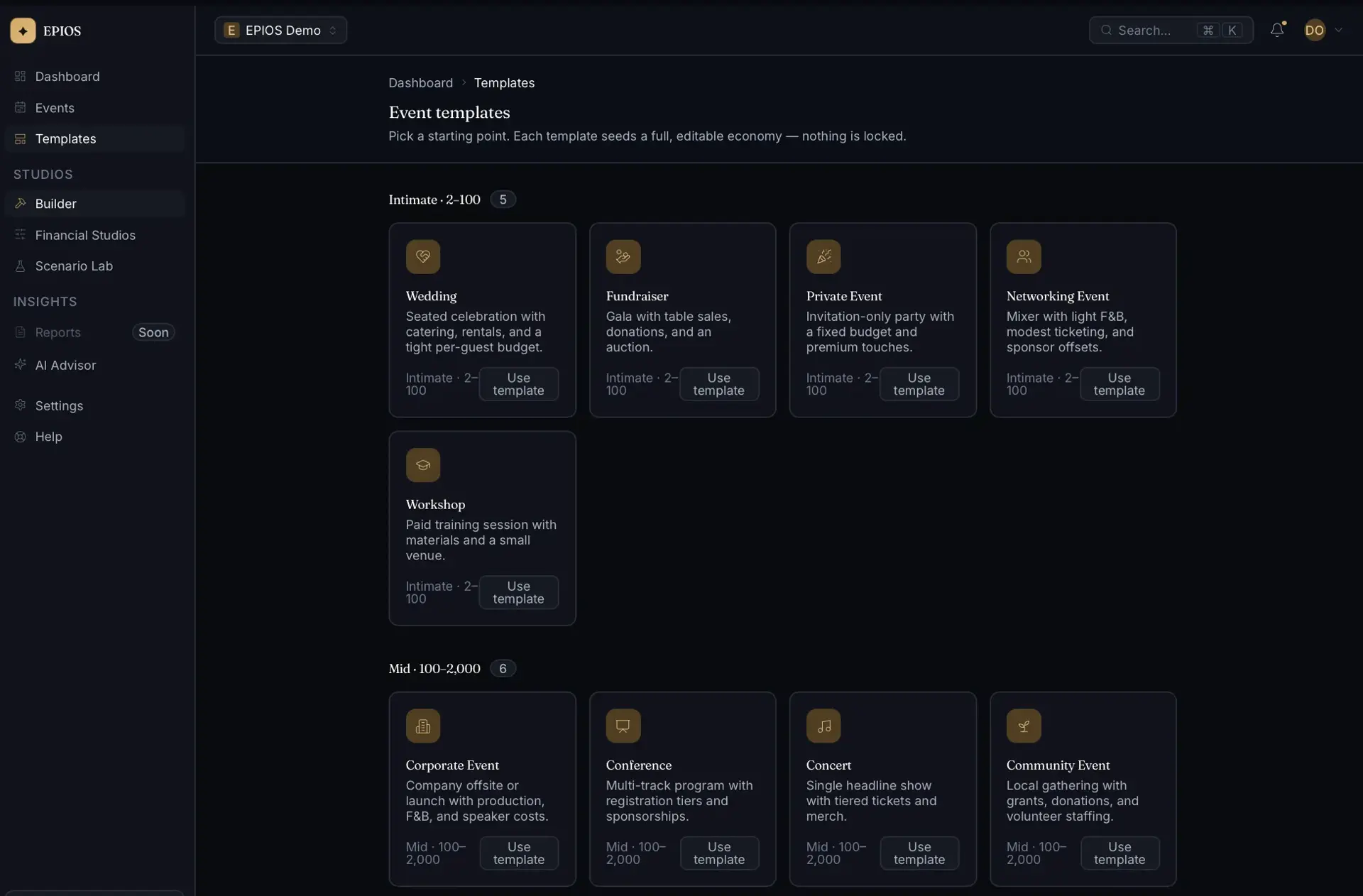
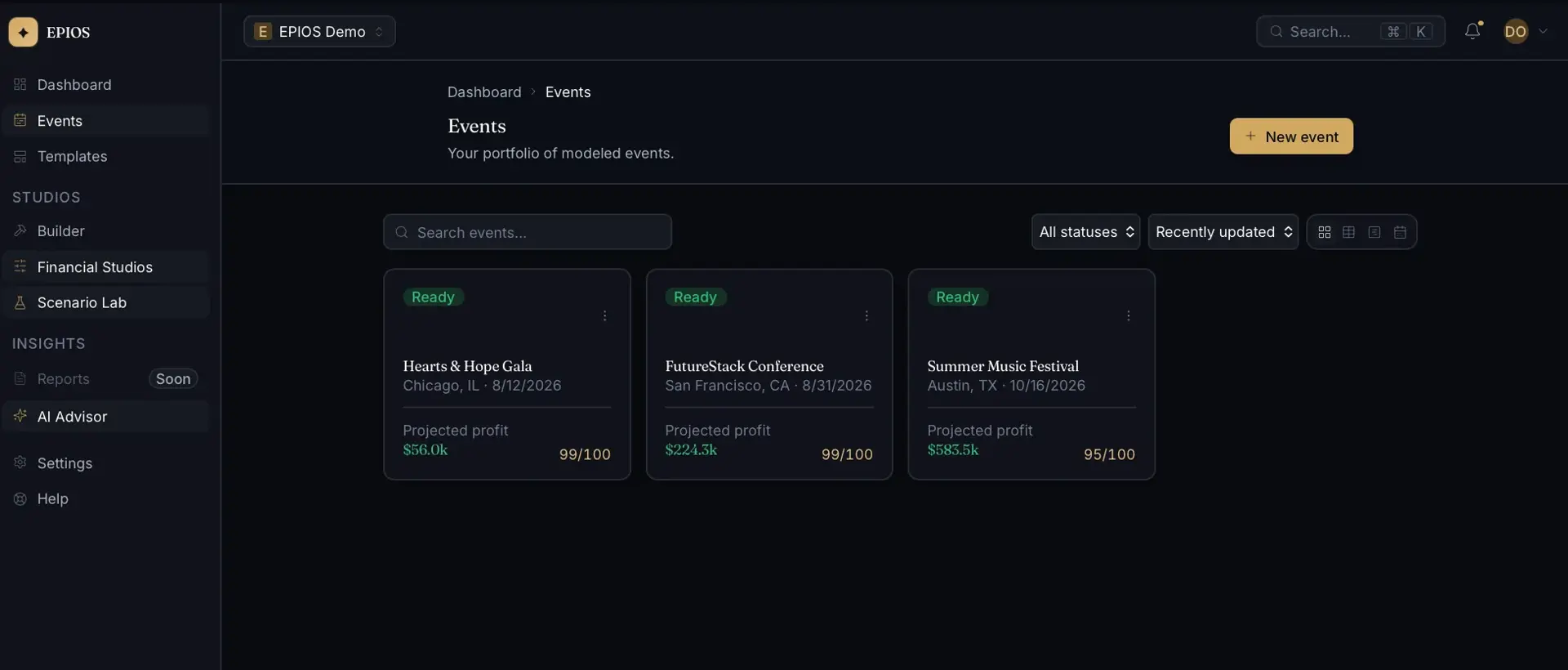
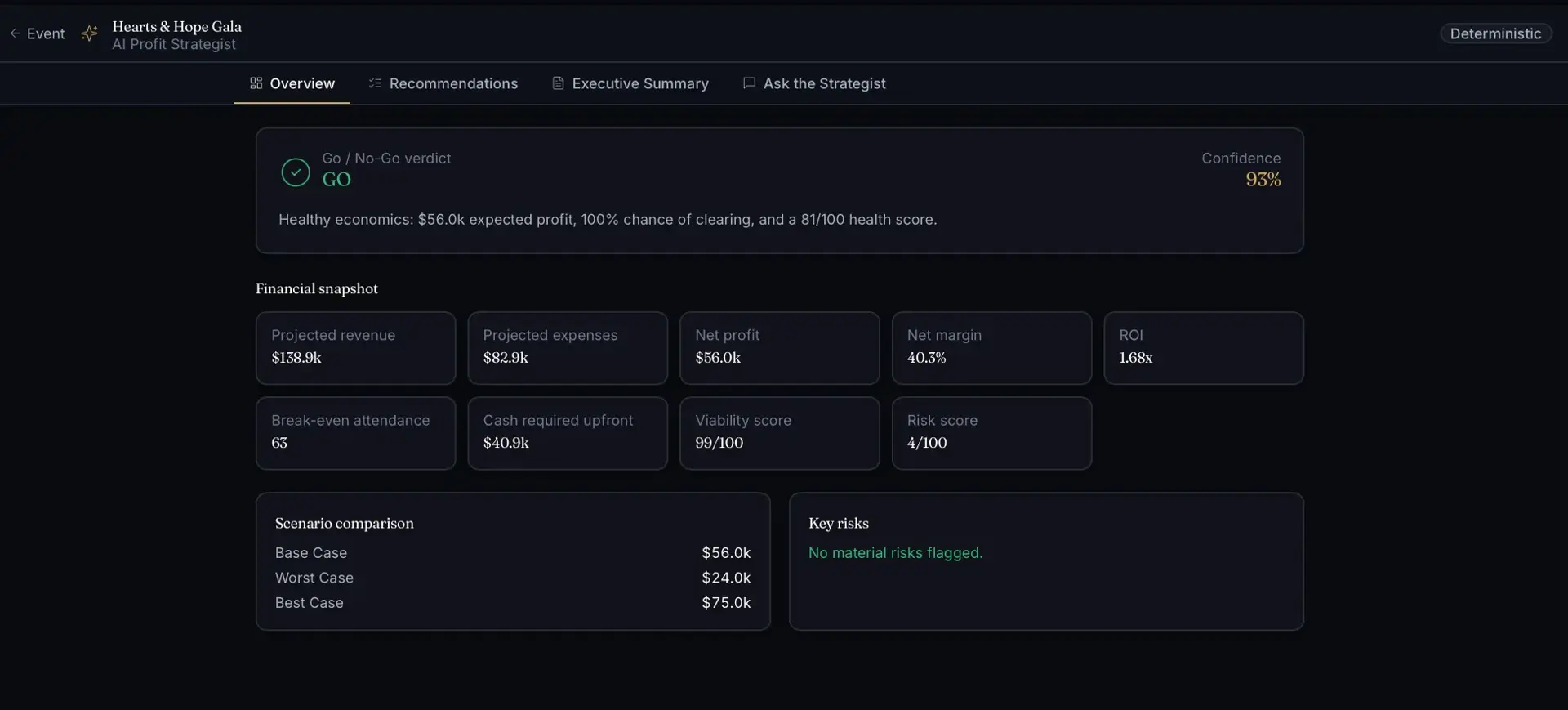
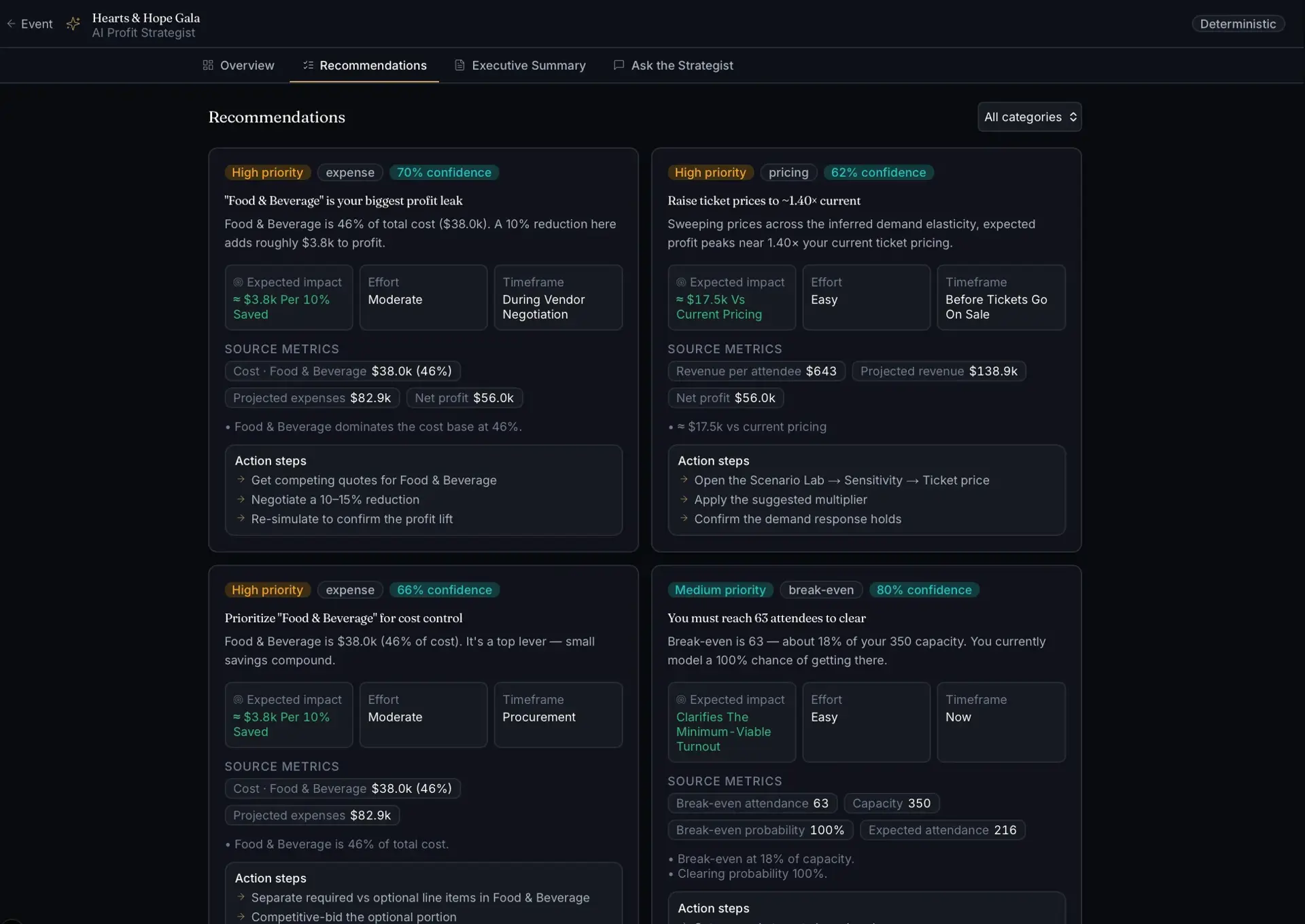
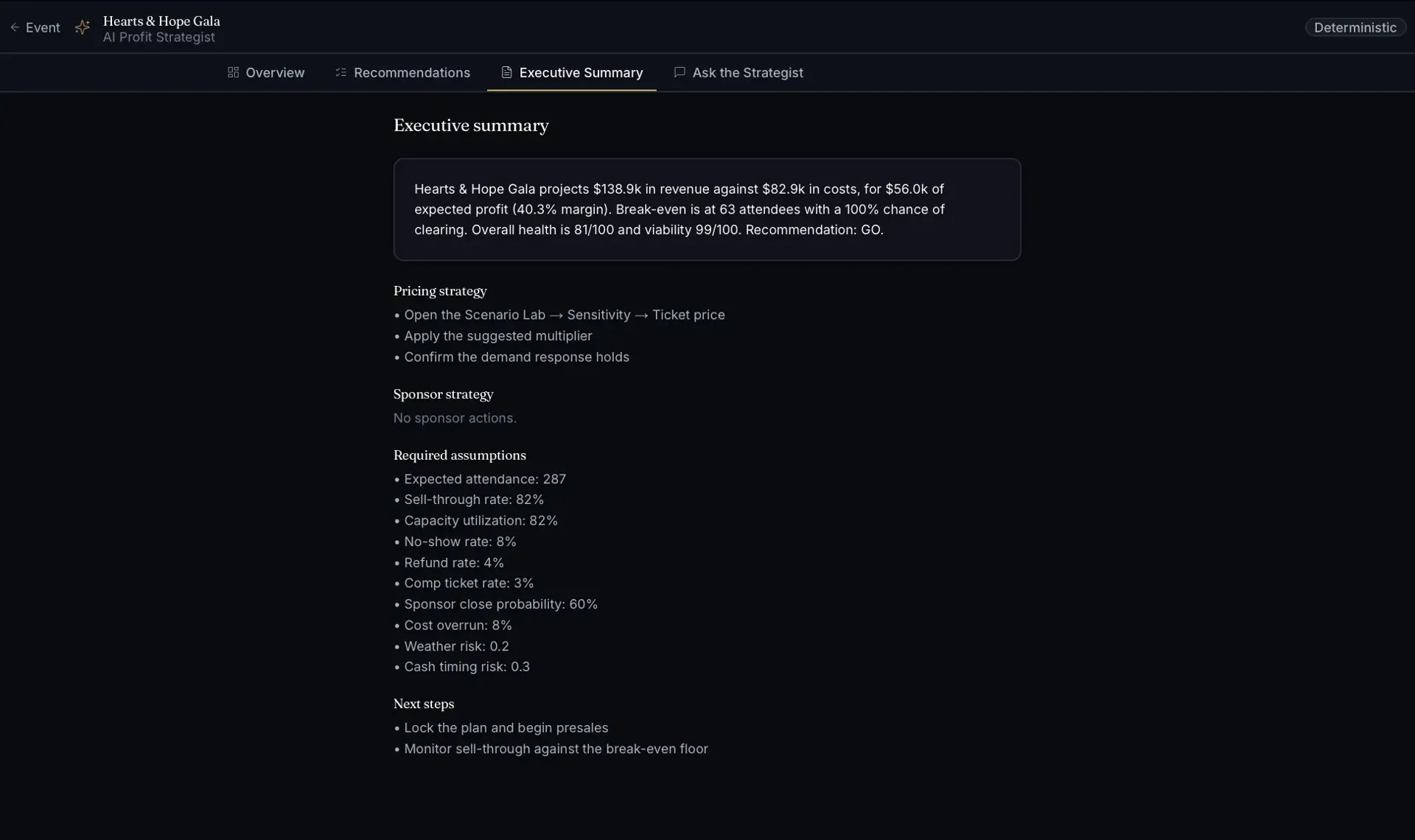
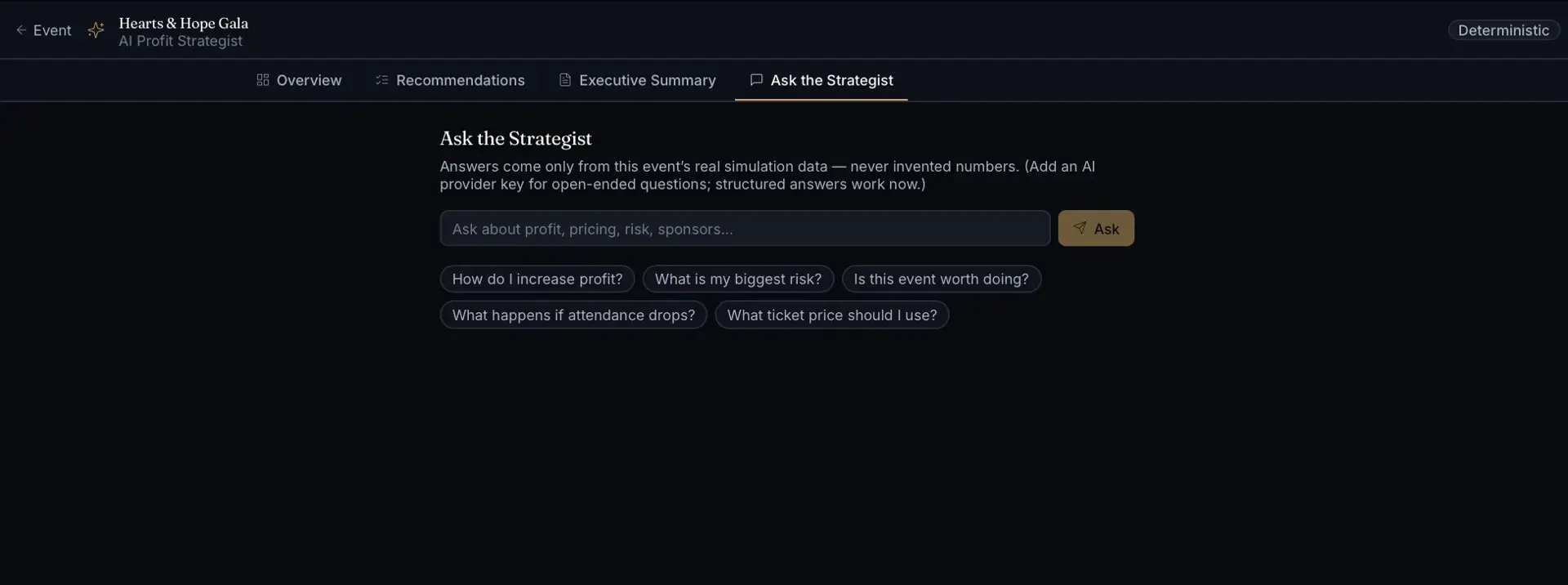
A Next.js and React application with a server-side simulation engine handling inference, revenue, cost, demand, risk, and strategy modeling. Data is persisted through Prisma against PostgreSQL, authentication uses signed JWT sessions with login throttling backed by Upstash Redis, and an optional AI provider layer calls Anthropic, OpenAI, or Gemini entirely server-side.
An AI-assisted labor capacity simulator that models the workforce needed to hit a production goal.
Enter a property once and compare flip, hold, Airbnb, seller finance, BRRRR, and wholesale exits side by side.
Model SaaS burn, runway, and hiring across scenarios, then produce board-ready reports.
Start a project and reference this one — the conversation begins with what you have already seen.
Start a project