 Built In Oasis

Real Estate Exit Strategy Simulator
Functional DemoEnter a property once and compare flip, hold, Airbnb, seller finance, BRRRR, and wholesale exits side by side.
An AI-assisted labor capacity simulator that models the workforce needed to hit a production goal.
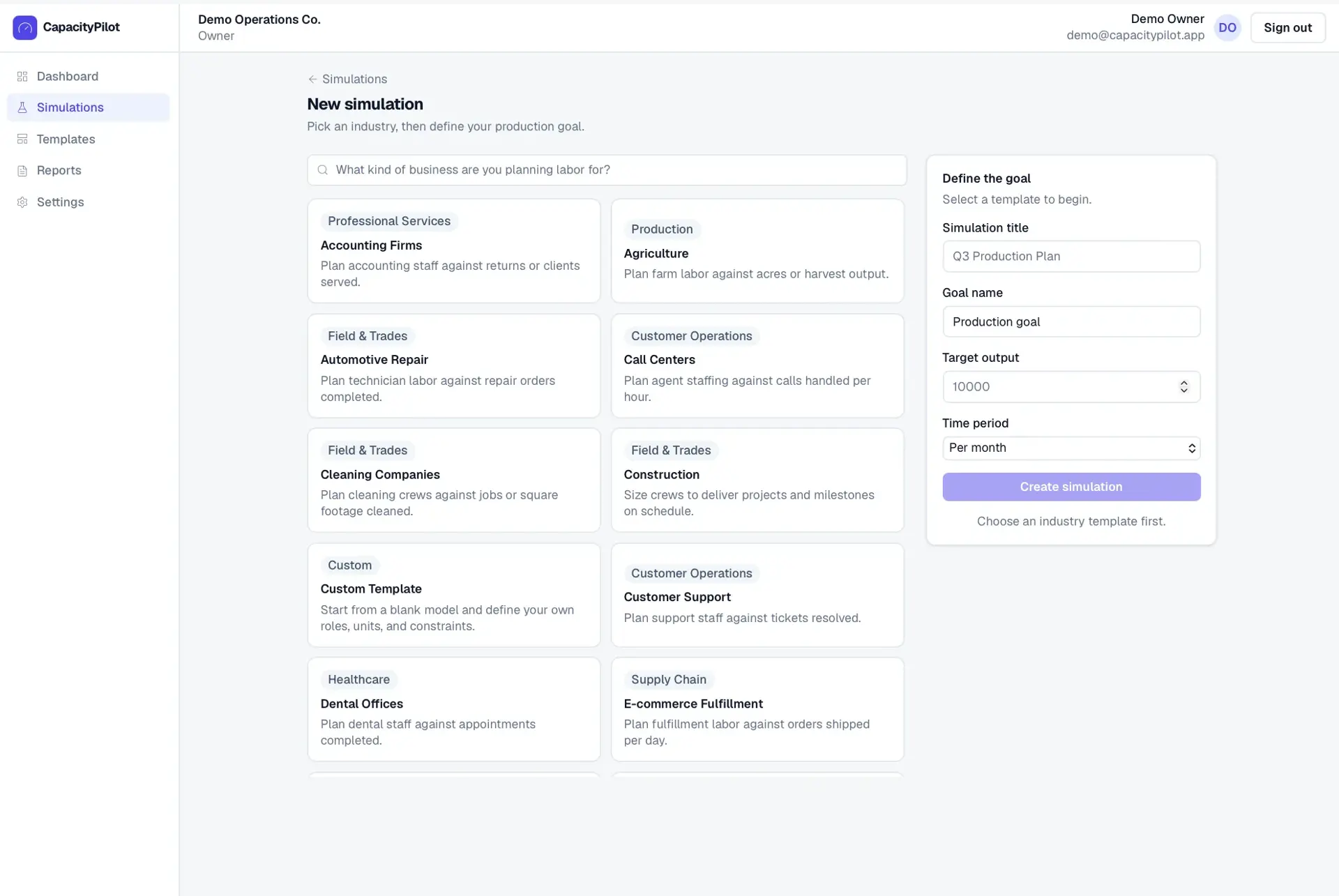
Figuring out how much labor is needed to hit a production goal is hard. Teams have to reconcile current workforce capacity, constraints, and cost against a target, then work out the right mix of hiring, overtime, and productivity gains. That analysis is usually done ad hoc in spreadsheets, without a clear plan, bottleneck view, or cost forecast.
Built for Operations and workforce planners modeling labor capacity against production goals.
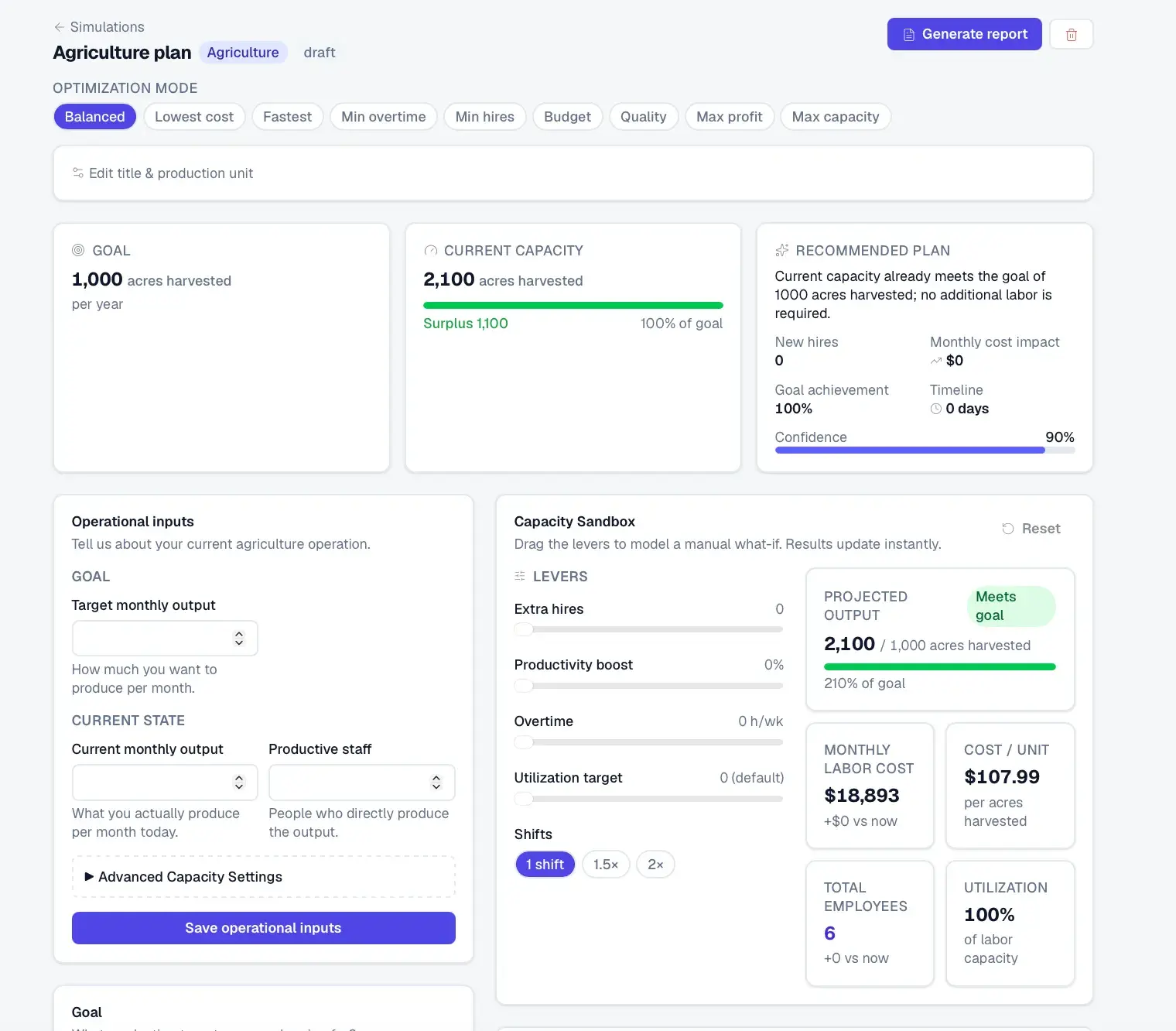
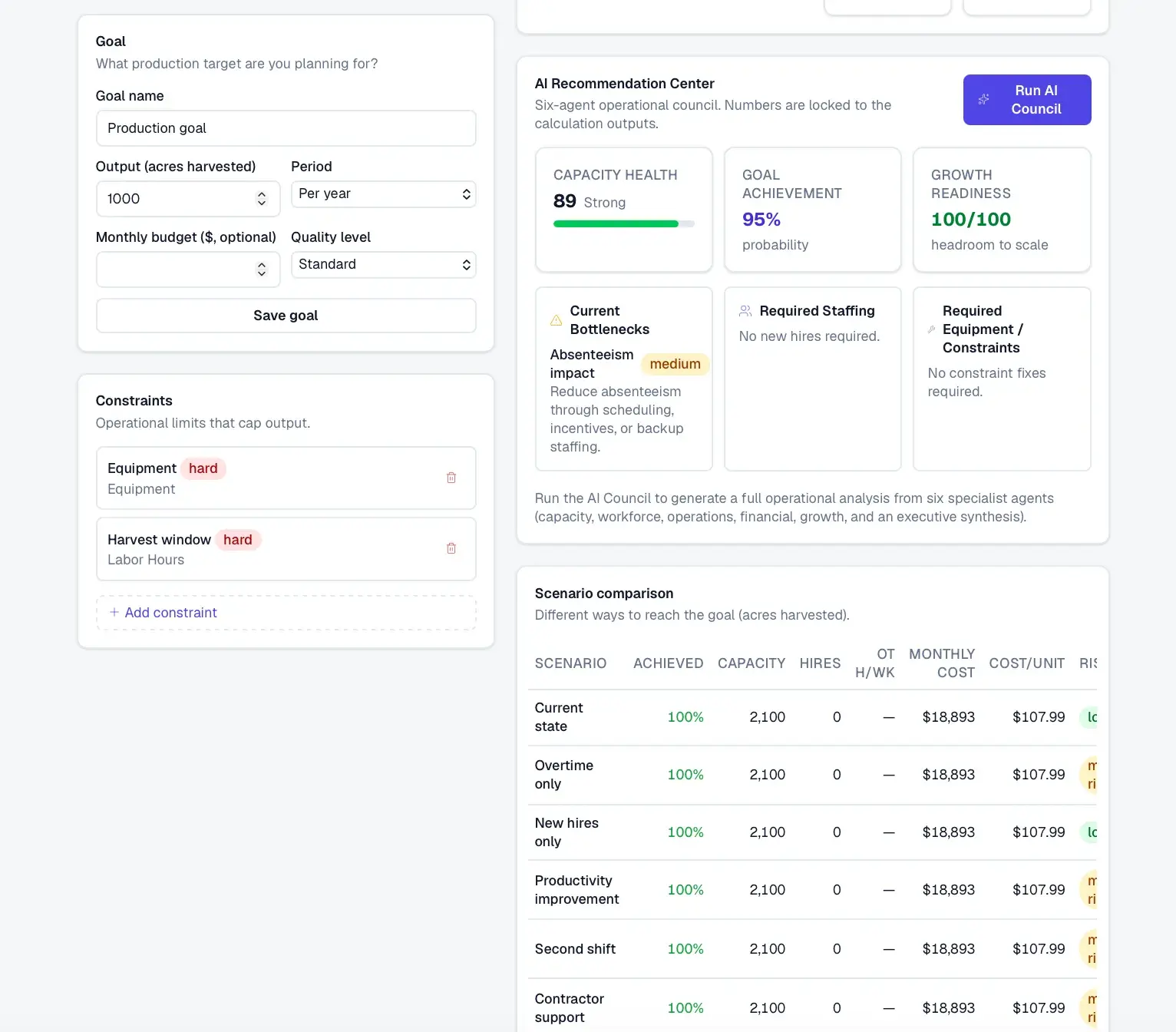
CapacityPilot is a labor capacity simulator. A user picks an industry, sets a production goal, and models their workforce and constraints; the app returns current capacity, the goal gap, an optimized hiring, overtime, and productivity plan, bottlenecks, and a cost forecast. A real-time Capacity Sandbox lets users adjust inputs live, a six-agent AI Operational Council reviews the plan, and industry playbooks compare it to best practice. Results compile into an executive report that can be exported to PDF or shared via a revocable link. Deterministic engines do the math, and the AI is guarded so it never invents numbers.
A suite of pure, deterministic, unit-tested calculation engines — capacity, workforce gap, optimizer, bottleneck, labor cost, scenario, roadmap, health, and report — cleanly separated from I/O. An AI council is layered on top with a guard that verifies every figure traces back to engine output, over a production SaaS spine of org-scoped multi-tenancy with five roles, Stripe plan enforcement, and Upstash-backed rate limiting.
The AI never invents numbers — a guard verifies that every figure in generated output traces back to a deterministic engine result.
Capacity Engine
Computes current production capacity from the workforce model.
Workforce Gap Engine
Measures the gap between capacity and the production goal.
Optimizer EngineHiring / Overtime / Productivity
Plans hiring, overtime, and productivity to close the gap.
Bottleneck Engine
Identifies the constraints limiting output.
Labor Cost Engine
Forecasts the cost of the plan.
Scenario Engine
Compares alternative capacity scenarios.
Health Engine
Scores operational health.
Roadmap Engine
Sequences the plan over time.
Capacity Sandbox
Adjust inputs and see capacity recompute live.
AI Operational Council6-agent AI Council
A six-agent Claude review of the plan.
Industry Playbooks
Compares the plan against industry best practice.
Industry Templates
40 templates with per-industry operational inputs.
Executive Report
Compiles results into an exportable, shareable report.
Billing & Plan Limits
Stripe subscriptions with enforced per-plan quotas.
Rate Limiting
Upstash Redis limiter with an in-memory fallback.
Capacity & Goal Gap
Production capacity derived from the workforce model.
The shortfall between capacity and the production goal.
The hiring, overtime, and productivity mix to close the gap.
Constraints that cap output.
Projected cost of the plan.
A score of the plan's operational health.
A Next.js 16 App Router application in TypeScript, with business logic in server-only services that orchestrate the engines and a Prisma database on PostgreSQL. Anthropic's Claude powers the AI council behind a provider interface with a deterministic fallback, Stripe handles subscriptions, and Upstash Redis provides rate limiting.
Enter a property once and compare flip, hold, Airbnb, seller finance, BRRRR, and wholesale exits side by side.
A self-serve AI knowledge hub that turns a company's documents into a role-based chatbot, SOPs, and training.
Strategy-based real estate deal-analysis SaaS that models rentals, flips, BRRRR, and creative-finance deals in minutes.
Start a project and reference this one — the conversation begins with what you have already seen.
Start a project