Functional DemoAI Platform

Marketing Master

Multi-tenant AI content and growth operating system that runs a portfolio of apps as one AI-managed business.
Marketing Master — cover

What it solves

Operating dozens to hundreds of apps, brands, products, and campaigns means content is produced app-by-app by hand, while marketing, outreach, sales, and revenue live in disconnected external dashboards. Nothing learns from what worked, so each app keeps repeating the same guesses. There is no single place to generate, produce, distribute, and optimize content across the whole portfolio, and no shared memory or attribution linking a piece of content to the revenue it drove.

Built for Operators running a portfolio of applications, brands, and products who want to manage marketing, sales, and growth from one interface.

Overview

Marketing Master (internal name "content-os") is a multi-tenant AI operating system that manages, produces, distributes, and optimizes content and growth across many applications from a single command center. Each app carries its own brand and content memory that drives high-volume idea generation, scoring, and script writing, which flow into AI media generation and multi-platform scheduling. A council of specialist AI agents deliberates, votes through a deterministic consensus gate, and — under configurable autonomy levels — plans and executes campaigns, outreach, and lead generation. A universal CRM, an outreach engine across email, LinkedIn, SMS, and voice, a shared growth-intelligence graph, and a content-attribution graph tie leads, deals, and revenue back to the content and campaigns that produced them.

What this demonstrates

Builds a large event-driven monorepo of 40+ domain services with multi-tenant Postgres row-level security, an append-only event log, and swappable memory/Drizzle repositories. The hard parts are real: a deterministic credibility-weighted consensus engine that gates every major action, a multi-model AI router with offline deterministic stubs for every provider, a provider-adapter pattern for media, outreach, and ad channels, a shared intelligence graph with in-code embeddings and cross-agent learning, and an autonomy gate that keeps spend-class actions human-approved. A standardized connector SDK onboards new apps with no architectural change.

What makes it different

Most tools help you make content. This runs a portfolio of applications as a single AI-managed business — content, outreach, sales, and revenue — from one command center.

  • Applications become business unitsThe AI Council operates above the apps; the apps do not operate above the AI.
  • Council, not a monolithic promptThe system reasons as an orchestrated council of specialists that propose, critique, and vote.
  • No major action without council reviewA deterministic consensus gate sits between deliberation and execution.
  • One shared intelligence coreEvery agent queries the same growth graph through its own memory filter; there is no isolated per-agent memory.
  • Spend-class actions never auto-executeReal-money and irreversible sends are human-gated below autonomous mode.
  • Every provider behind an adapterMedia, outreach, and ad channels ship deterministic stubs so nothing is hardcoded and everything is reproducible offline.
  • Multi-tenant, event-driven, auditableRow-level security everywhere and an append-only event log that records every decision, vote, and action.
  • Real vs modeled provenanceEvery metric carries a source flag; modeled numbers are never presented as real.

Core capabilities · 18

  • Creative Intelligence EnginePer-App Memory

    Gives each app its own brand DNA, content DNA, and rules, with vector memory of scripts, hooks, ideas, and performance.

  • Idea Generation & Scoring EngineIdea Lab

    Generates high-volume structured ideas per app and scores them on virality, brand fit, production complexity, clarity, and engagement.

  • Script Generation Engine

    Converts approved ideas into HeyGen-ready scripts with platform variants, pacing instructions, and voice direction.

  • Media Generation Pipeline

    Turns scripts into avatar video, cinematic clips, and repurposed shorts through HeyGen, Kling, and fal.ai model routes.

  • AI Council9 Agents

    A nine-seat roster runs propose, critique, score-consensus, and synthesize with multi-model rotation across Claude, Sonnet, and Haiku.

  • Consensus EngineConsensus Gate

    Pure, deterministic credibility-weighted voting that computes a modal action and confidence and gates execution.

  • Autonomous Mode FrameworkAutonomy Levels

    Five autonomy levels from manual to Growth OS, with a confidence floor and spend-class actions gated below autonomous.

  • Growth Intelligence GraphShared Memory

    One shared intelligence core with in-code embeddings, insight detectors, and cross-agent learning fed by the event bus.

  • Content Graph EngineAttribution Brain

    Attribution and lineage graph tracing campaign to idea to script to video to ad to lead to customer to revenue, forward and backward.

  • Universal CRM

    Companies, contacts, leads, deals, meetings, tasks, activities, and email/SMS/call logs shared across every application.

  • Lead Discovery & Scoring

    Provider-adapter discovery feeding a deterministic eight-factor lead scoring model.

  • Outreach Engine

    Executes email, LinkedIn, SMS, and voice through provider adapters with a sequence engine and AI-generated, non-generic messaging.

  • AI Campaign Builder

    Turns a plain goal into council-reviewed audience, offer, multi-channel sequences, budget, and a launch plan for approval.

  • Calling (AI SDR)

    Generates dynamic call flows, runs a call-council review, and tracks length, qualification, and revenue attribution.

  • Revenue Optimization

    Monitors CAC, LTV, ROAS, conversion, and pipeline velocity and emits council-reviewed budget and channel recommendations.

  • Distribution Engine

    Schedules and publishes content across platforms and manages calendars through Metricool.

  • Feedback Loop Engine

    Ingests analytics, computes performance scores, extracts winning patterns, and updates each app's memory and strategy.

  • App Connector Framework

    One standardized bidirectional connector contract pushes leads, revenue, and activity in and receives audiences, campaigns, and content out.

How it works

Content pipeline

  1. Load per-app brand and content memory
  2. Generate high-volume ideas for the app
  3. Score ideas and approve or reject in the Idea Lab
  4. Generate platform-specific scripts for approved ideas
  5. Produce media via HeyGen and Kling
  6. Repurpose long-form into short clips
  7. Schedule and publish across platforms via Metricool
  8. Ingest performance analytics
  9. Extract winning patterns and update app memory

Growth & outreach

  1. Discover and enrich leads through provider adapters
  2. Score leads with the eight-factor model
  3. Submit the campaign goal to the AI Council
  4. Council reviews and votes through the consensus gate
  5. Build audience, offer, and multi-channel messaging
  6. Generate outreach sequences per channel
  7. Approve or auto-execute per autonomy mode
  8. Execute across email, LinkedIn, SMS, and voice
  9. Track responses and book meetings
  10. Feed outcomes into revenue optimization

How the council score works

Consensus confidence

  • Consensus55%

    Weighted agreement on the modal action lever across seats.

  • Average conviction30%

    Mean conviction of the participating seats' positions.

  • Critique load25%

    Penalty from risk and devil's-advocate rebuttals.

  • Learning bias10%

    Adjustment from accumulated cross-agent learning.

  • Credibility weighting

    Each seat's conviction is scaled by its calibration accuracy before voting.

  • Falsifiable prediction calibration

    Seats attach predictions scored against realized outcomes, earning or losing future authority.
Key screens

  • Portfolio Overview DashboardConnected apps, revenue/leads/campaigns by app, growth trends, and active automation status.
  • Application WorkspacePer-app marketing, revenue, users, operations, infrastructure, intelligence, and settings.
  • Idea LabIdea stream with filtering, bulk approve/reject, script generation, and production dispatch.
  • AI CouncilActive agents, per-agent calibration health, recommendations, voting history, and consensus reports.
  • OutreachCampaigns, sequences, provider channels, and pending message approvals.
  • AutomationAutonomy modes and the queue of pending approvals awaiting a human.
  • RevenueCAC, LTV, ROAS, pipeline, and portfolio revenue intelligence.
  • Content Intelligence LibraryEvery asset across the portfolio with search, versioning, tagging, and cross-app discovery.
  • Scheduling Command CenterCalendar, queue, platform, and campaign views for cross-app distribution.
  • Operations Command CenterJobs, queues, workflows, and autopilot cycles with pause, resume, and rerun.
  • Infrastructure Command CenterIntegration keys, quotas, health, rate limits, and provider switching.
  • Executive CopilotNatural-language control, search, and reporting over the entire portfolio.

Data model

  • apps
  • brands
  • content_items
  • ideas
  • assets
  • analytics
  • app_memory_vectors
  • outcome_facts
  • event_log
  • crm_companies
  • crm_contacts
  • crm_leads
  • crm_deals
  • crm_meetings
  • crm_tasks
  • crm_activities
  • crm_emails
  • crm_sms
  • crm_calls
  • outreach_campaigns
  • outreach_enrollments
  • outreach_messages
  • ago_decisions
  • ago_actions
  • ago_outcomes
  • ago_agent_calibration
  • intelligence_embeddings
  • intelligence_edges
  • ad_deployments

Screens · 17

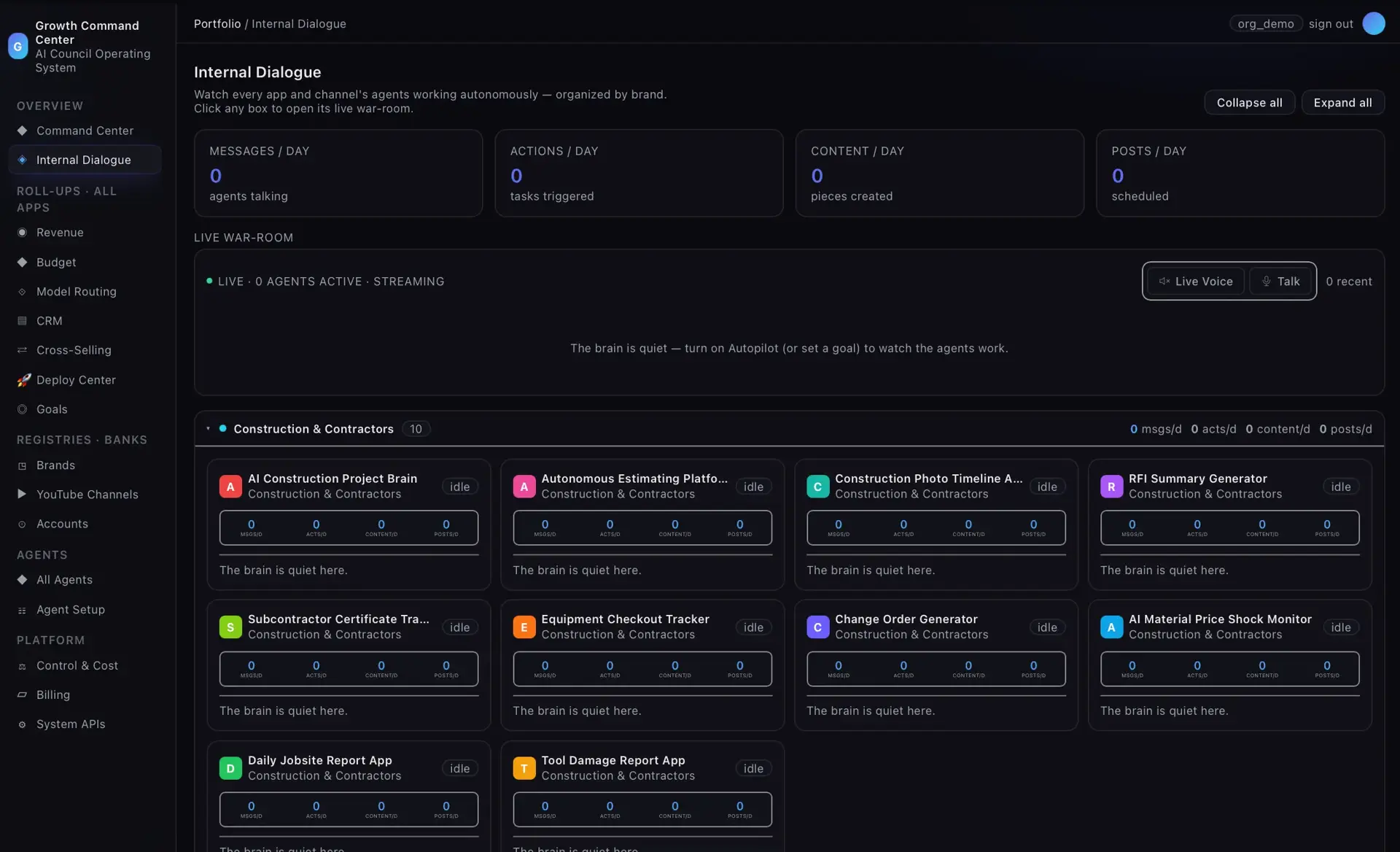
Internal Dialogue view showing per-brand agent cards for Construction & Contractors apps, all marked idle with zero messages, actions, content, and posts per day.
Agent internal dialogue
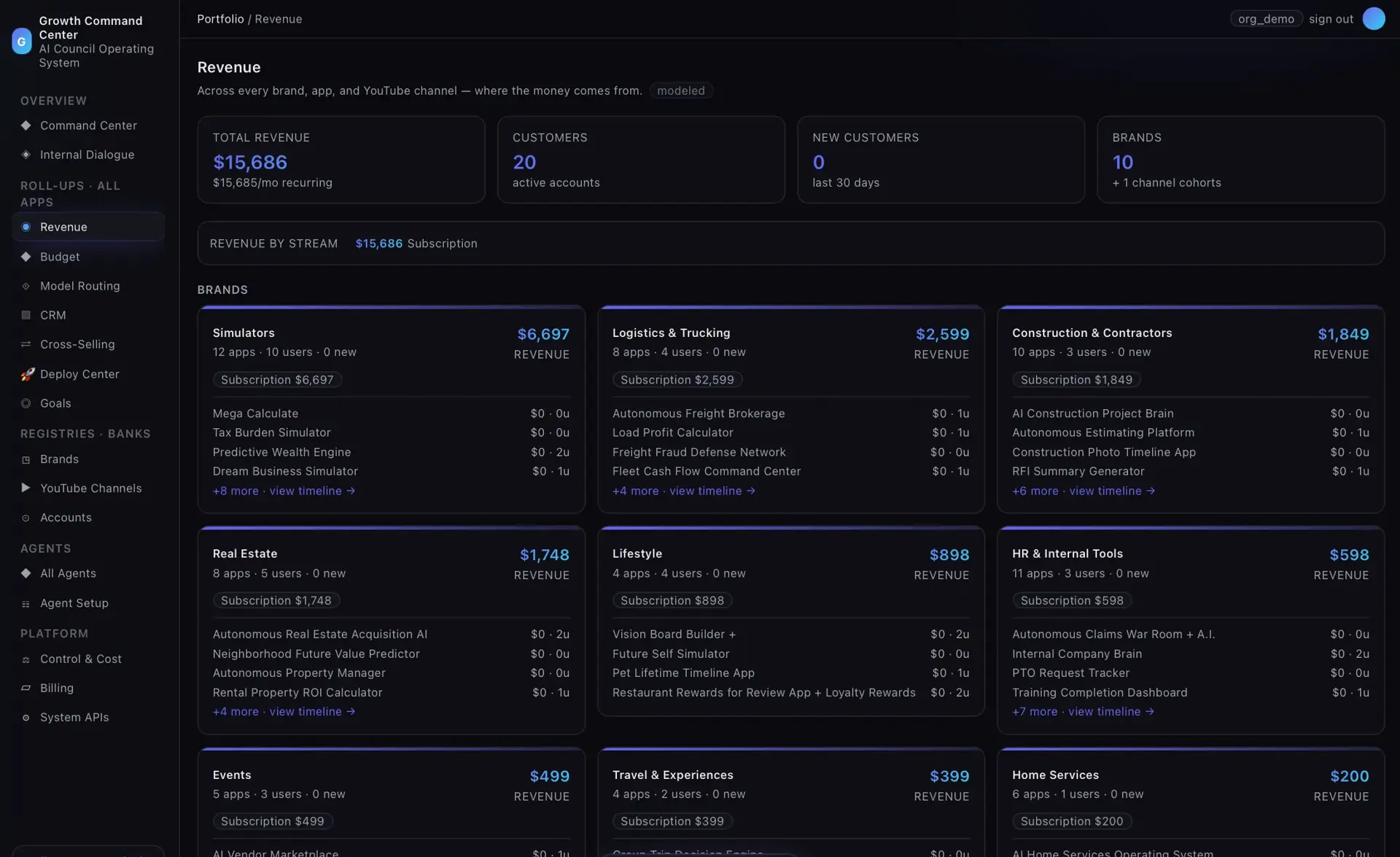
Revenue roll-up showing $15,686 total, 20 customers, and per-brand revenue cards for Simulators, Logistics, Construction, Real Estate, and more.
Revenue by brand
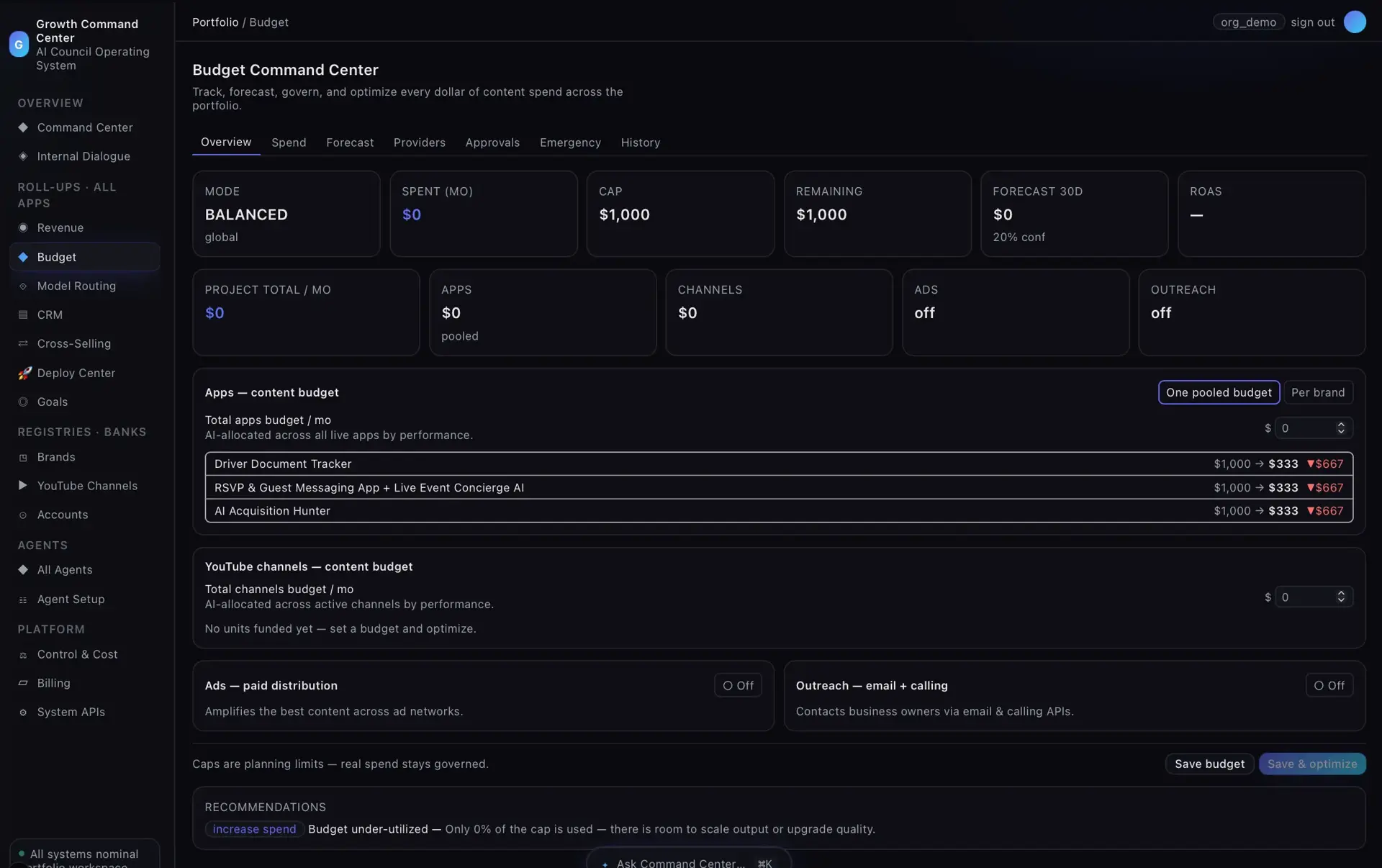
Budget Command Center with balanced mode, $1,000 cap, $0 spent, and AI-allocated per-app content budgets shown as pooled amounts.
Budget overview
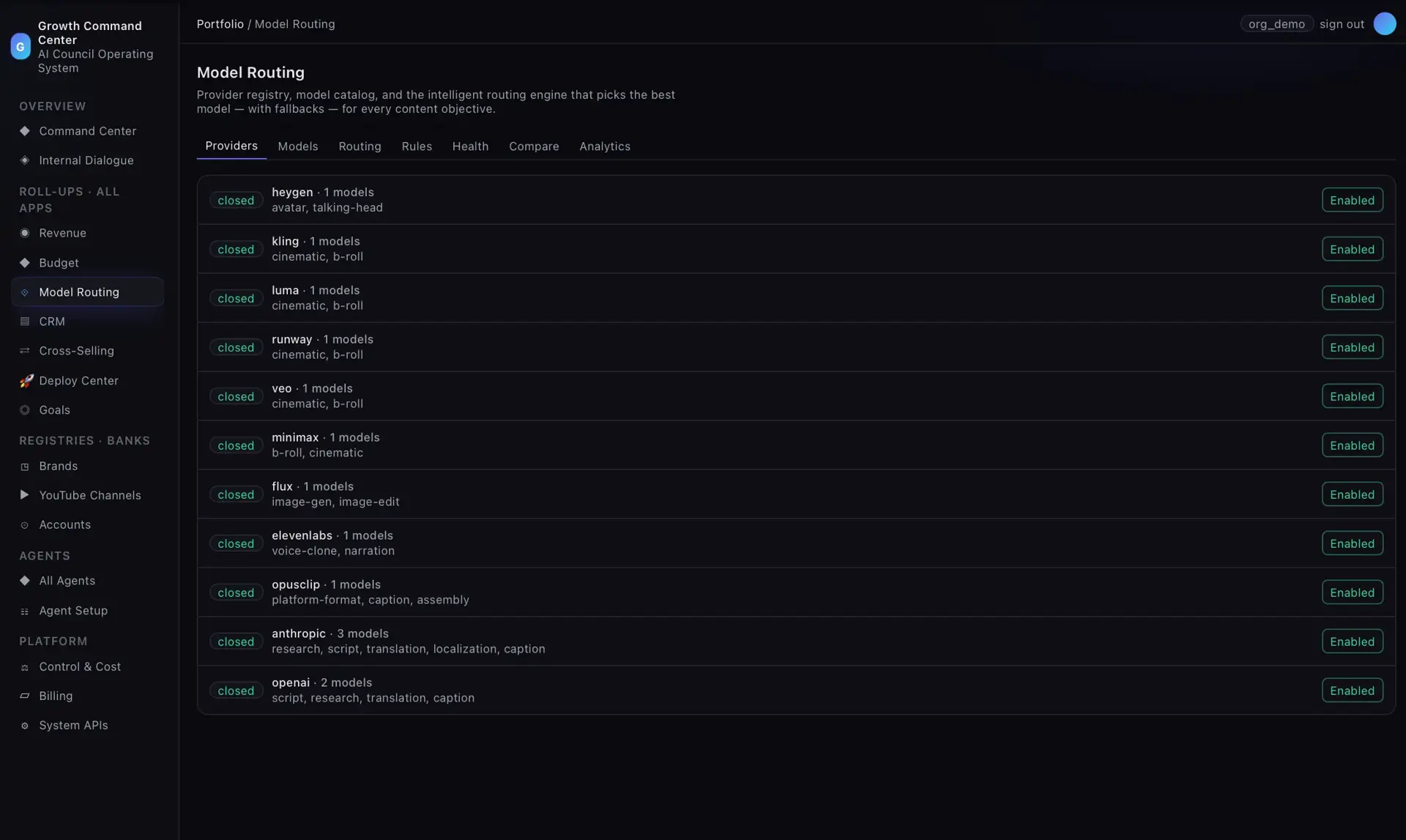
Model Routing providers list showing heygen, kling, luma, runway, veo, flux, elevenlabs, anthropic, openai and others, each closed and enabled.
Model routing providers
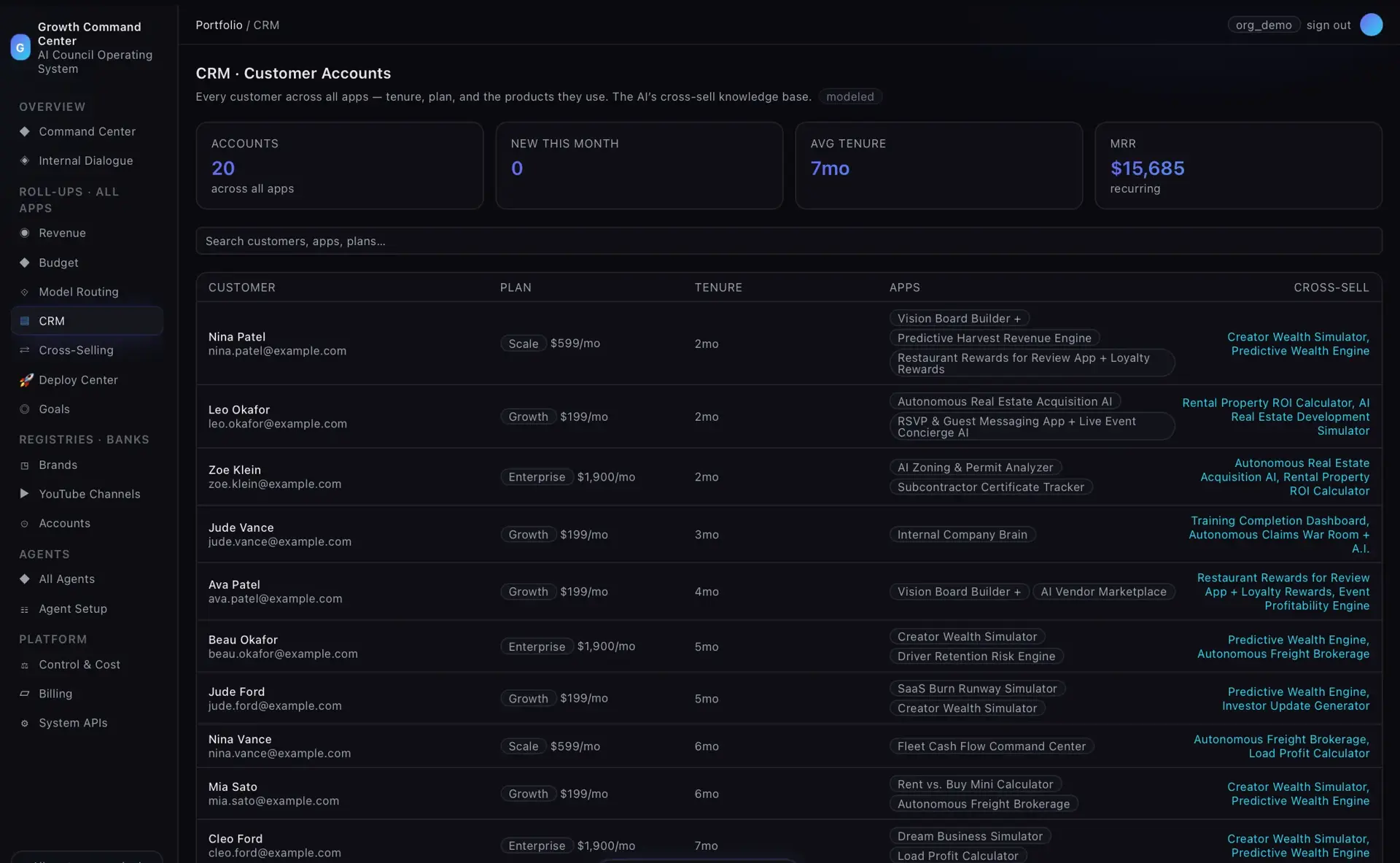
CRM customer accounts table with 20 accounts, listing name, plan, tenure, apps used, and cross-sell recommendations per customer.
CRM customer accounts
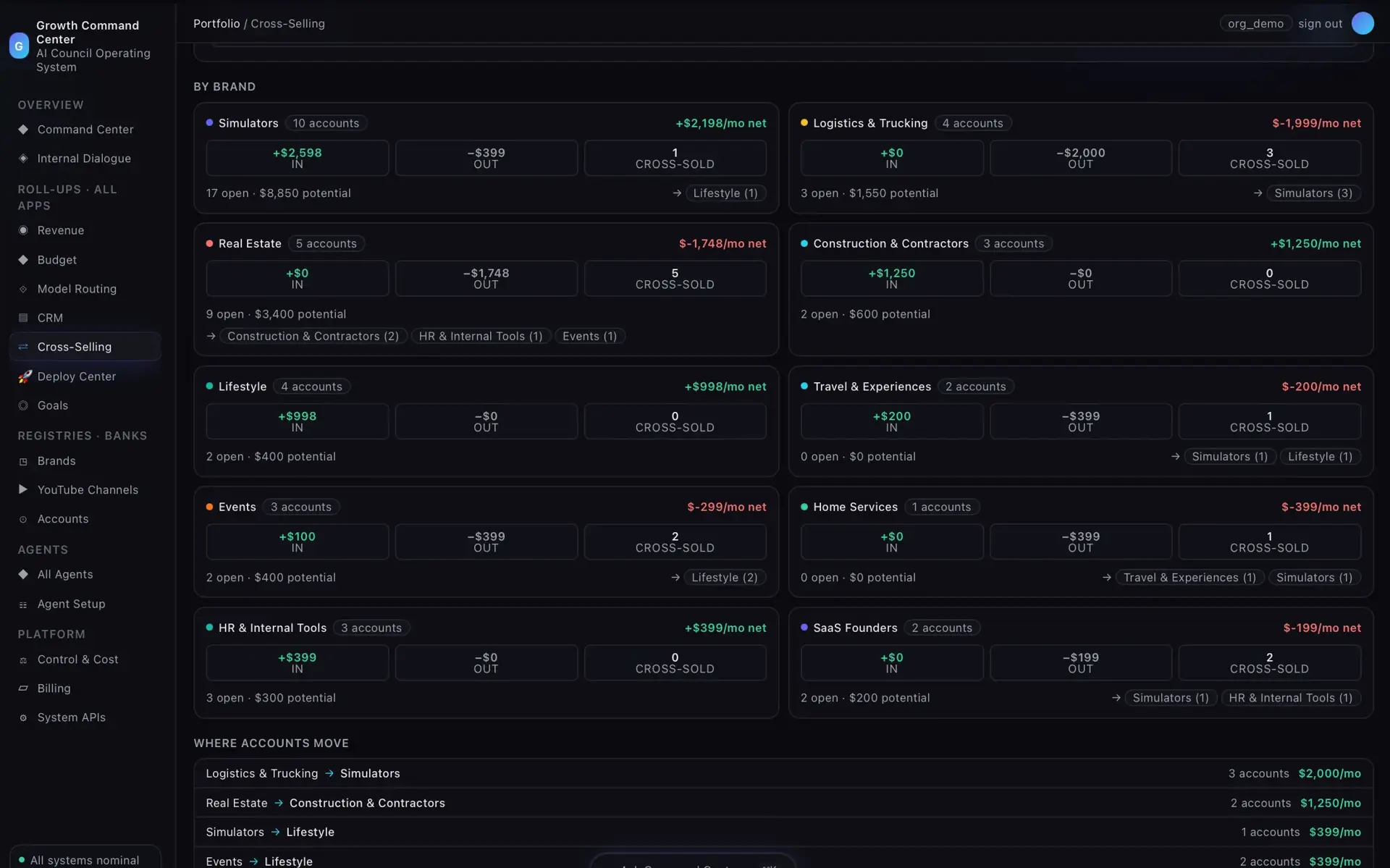
Cross-Selling view with per-brand cards showing monthly net, cross-sold counts, open opportunities, and where accounts move between brands.
Cross-sell by brand
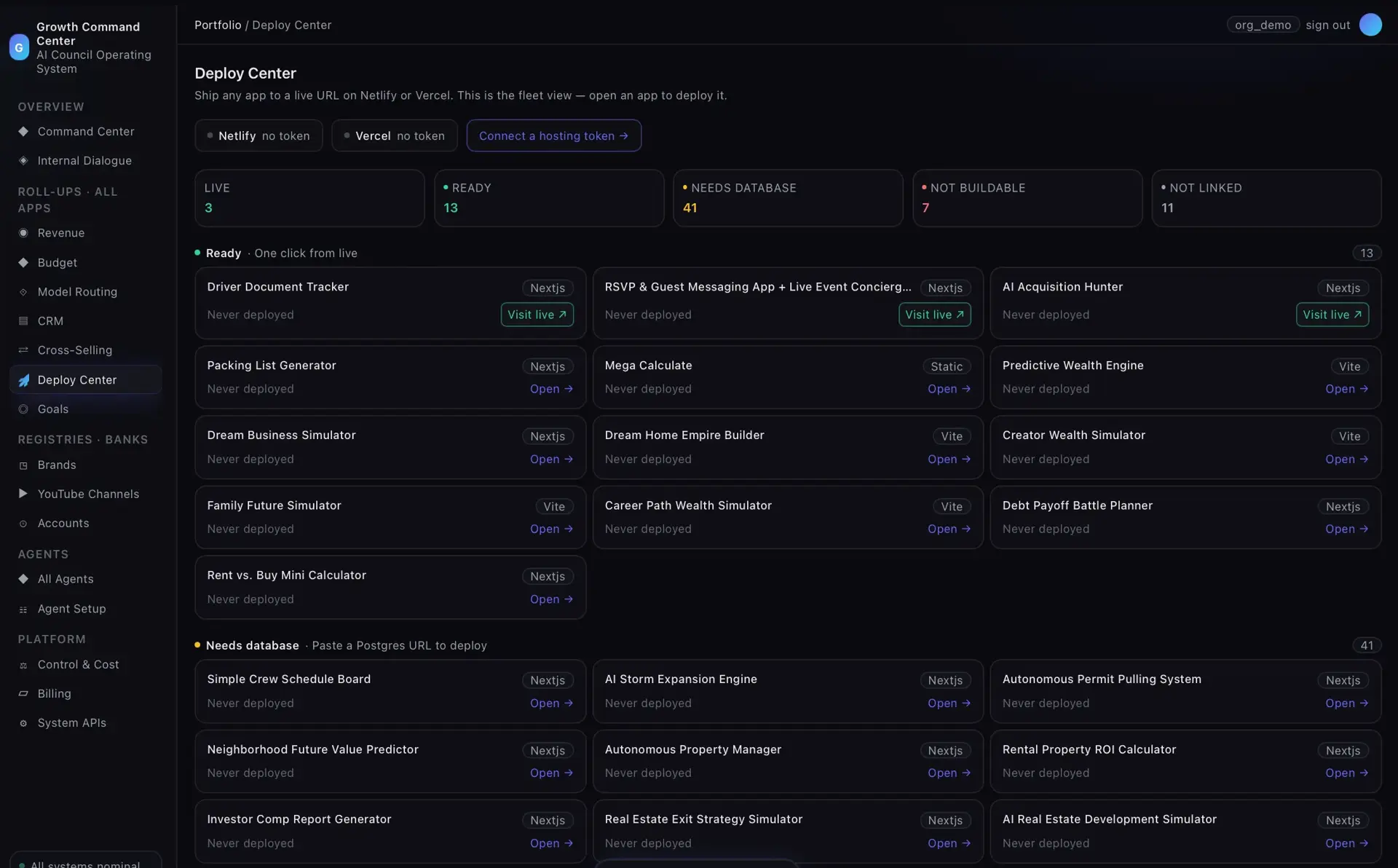
Deploy Center fleet view: 3 live, 13 ready, 41 need database, 7 not buildable, with app cards showing Next.js/Vite framework and deploy links.
Deploy Center fleet
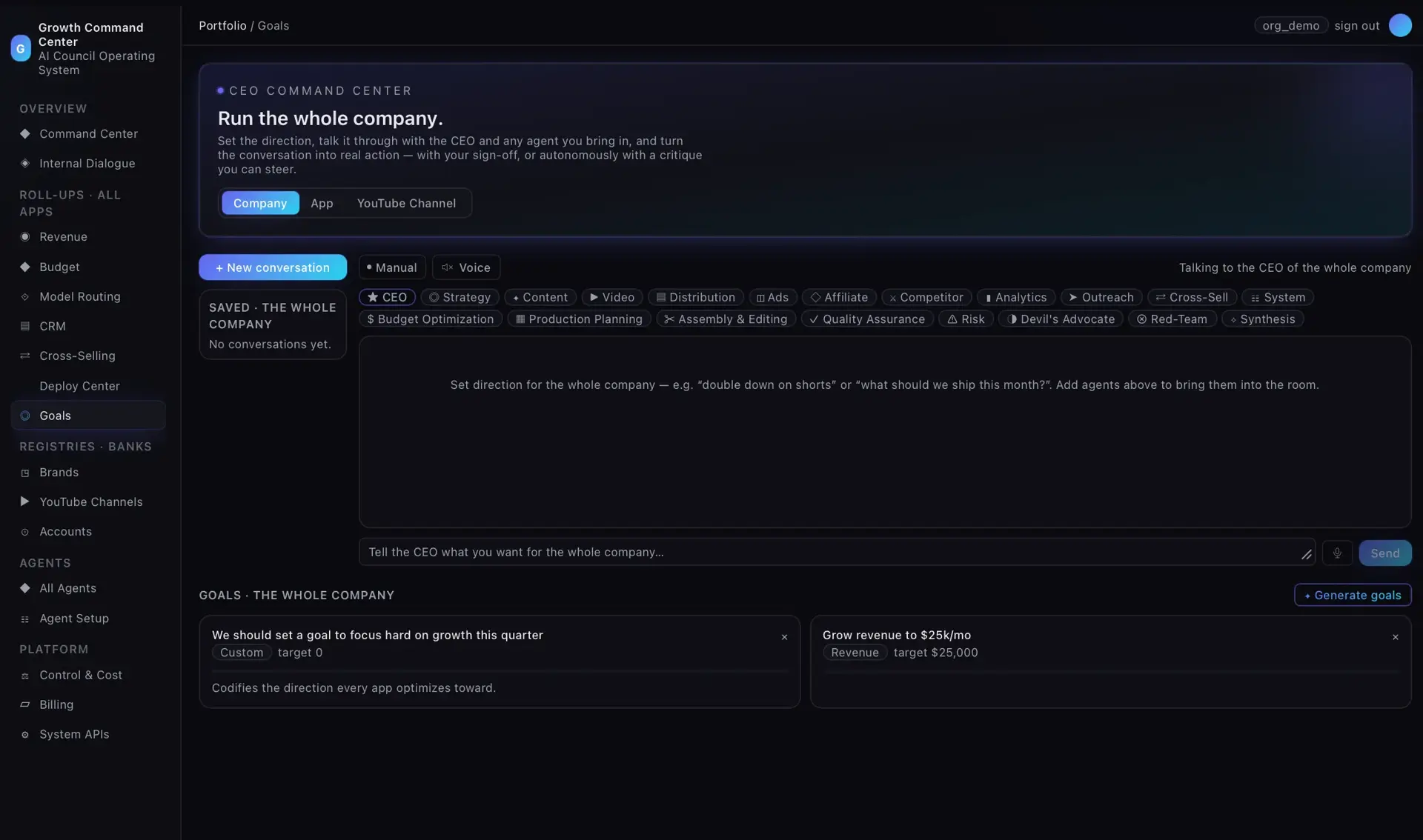
Goals CEO Command Center with an agent chat composer, specialist role chips, and saved company goals like grow revenue to $25k/mo.
Goals / CEO chat
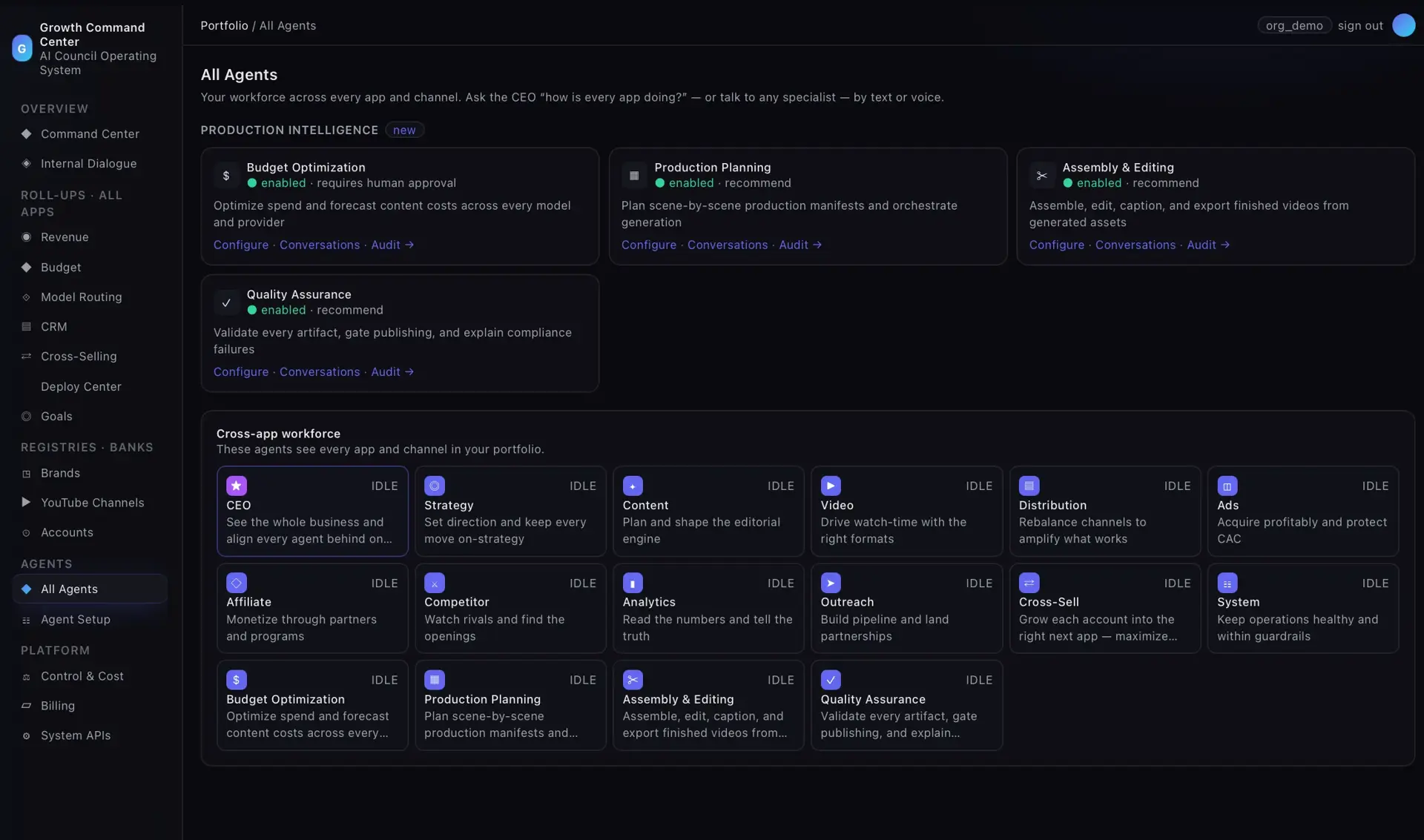
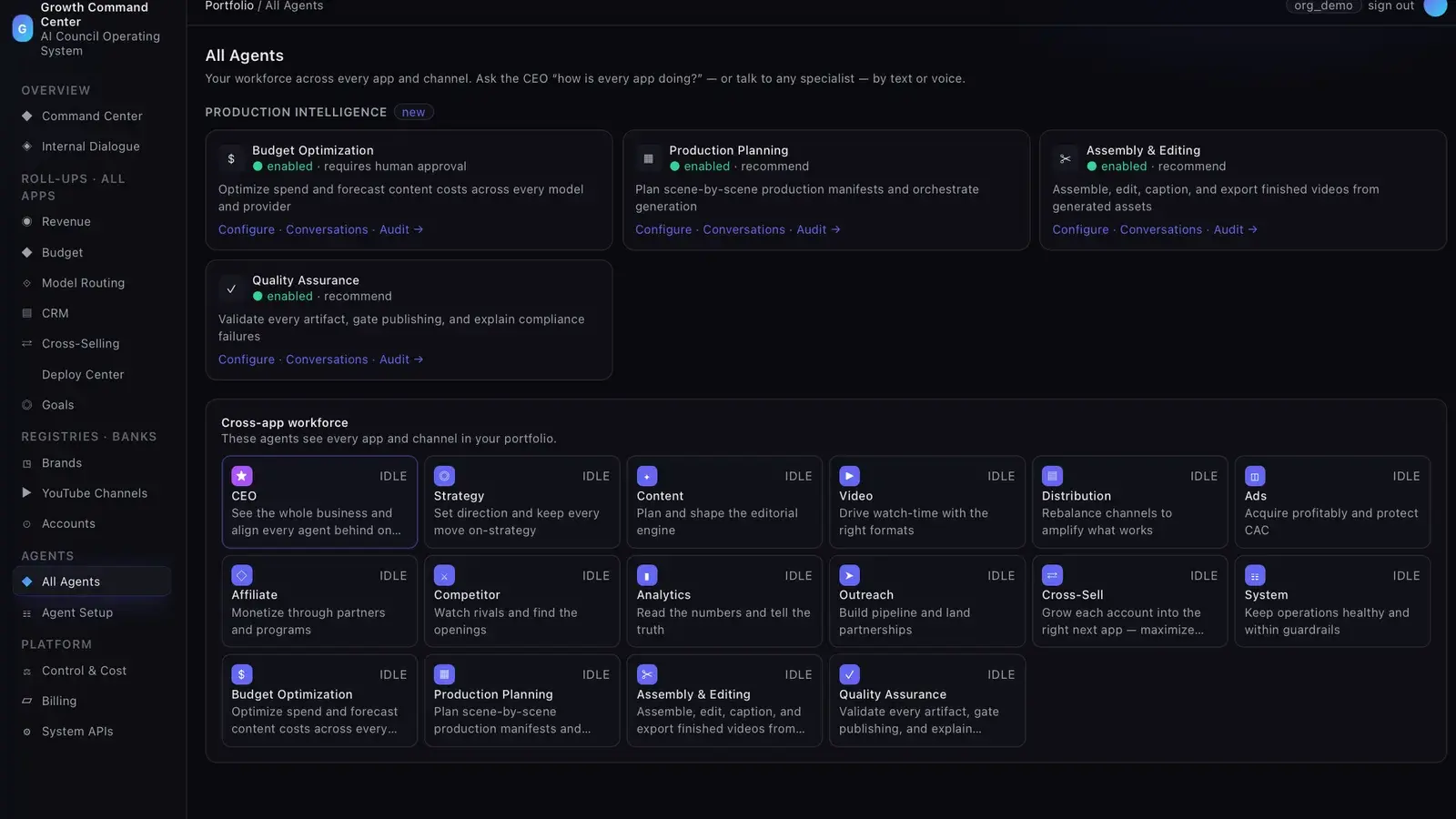
All Agents page listing production-intelligence agents and a cross-app workforce grid (CEO, Strategy, Content, Video, etc.), all idle.
Agent workforce
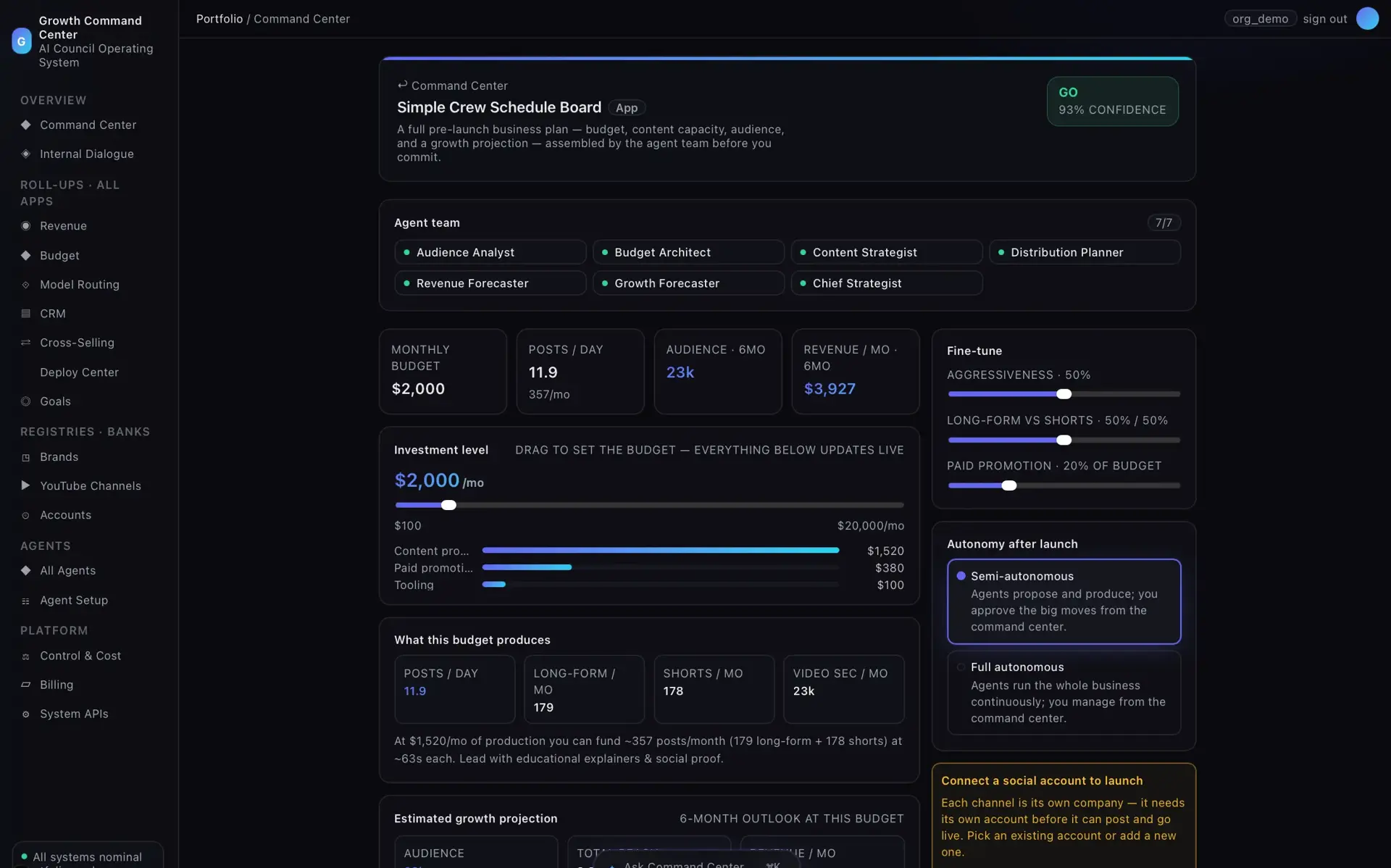
Command Center pre-launch plan for Simple Crew Schedule Board with agent team, investment slider at $2,000/mo, and growth projection.
App launch plan
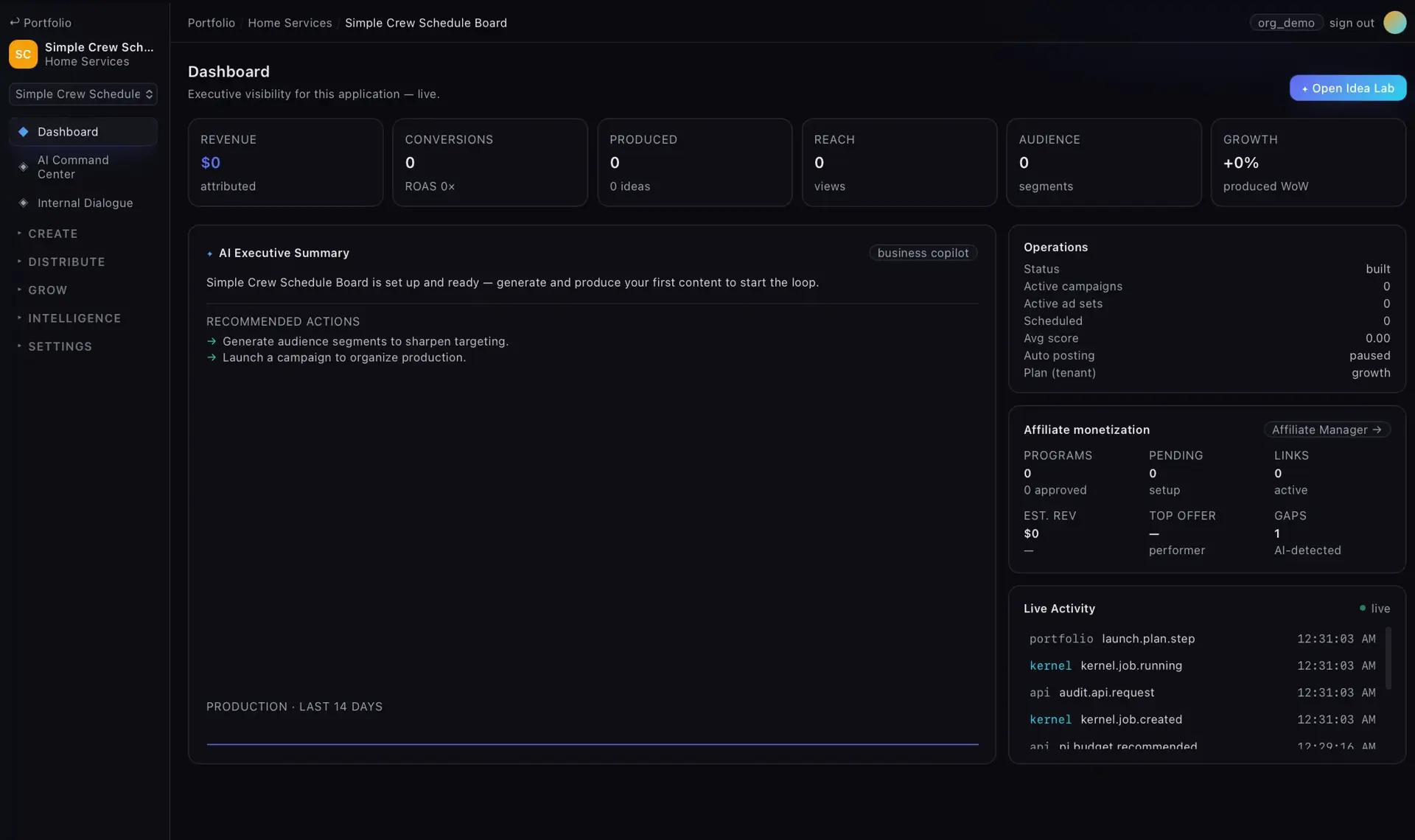
Simple Crew Schedule Board app dashboard with revenue, conversions, reach metrics all at zero, an AI executive summary, and a live activity log.
App dashboard
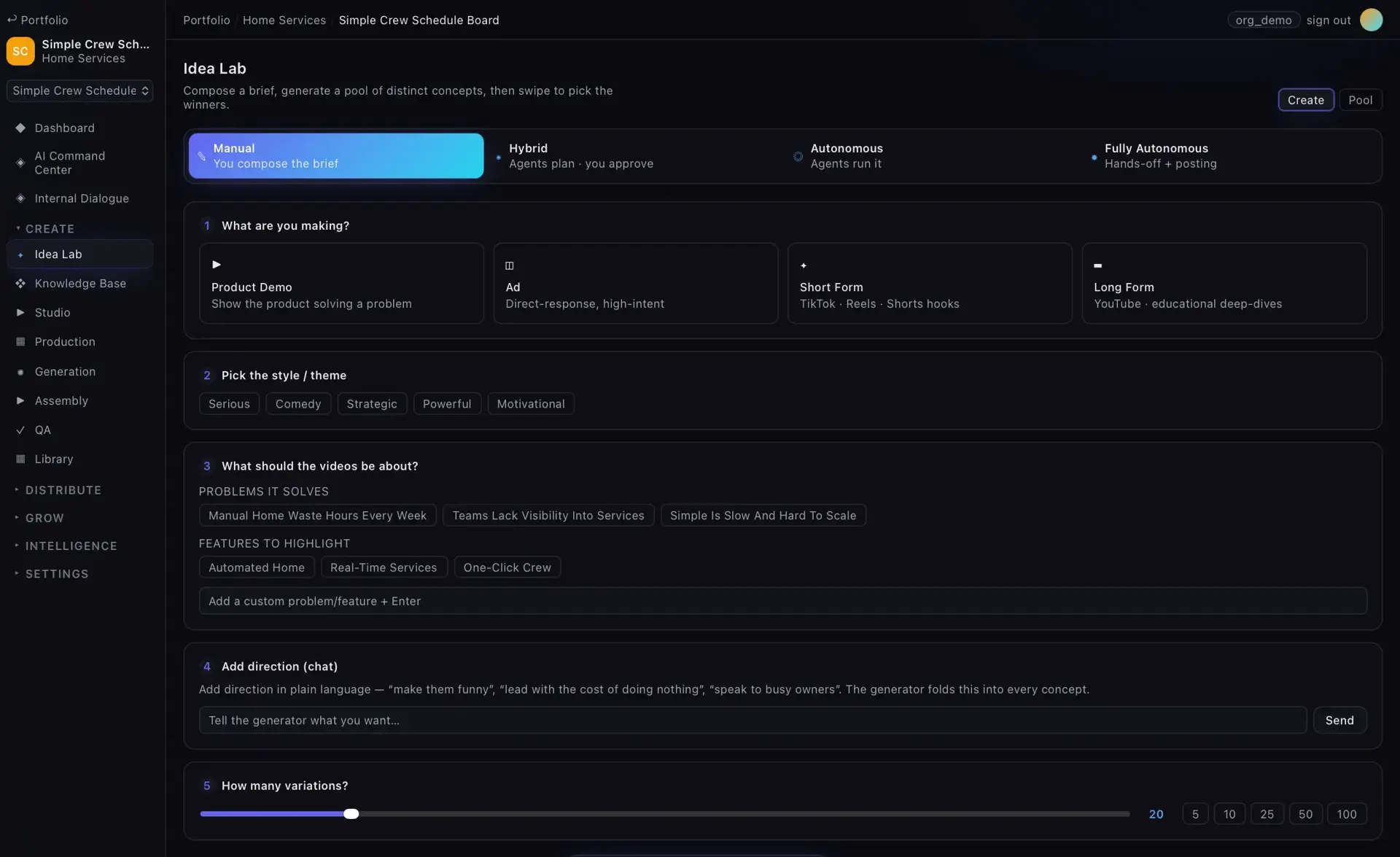
Idea Lab brief builder: pick content type, style/theme, problems and features to highlight, add chat direction, and set number of variations.
Idea Lab brief
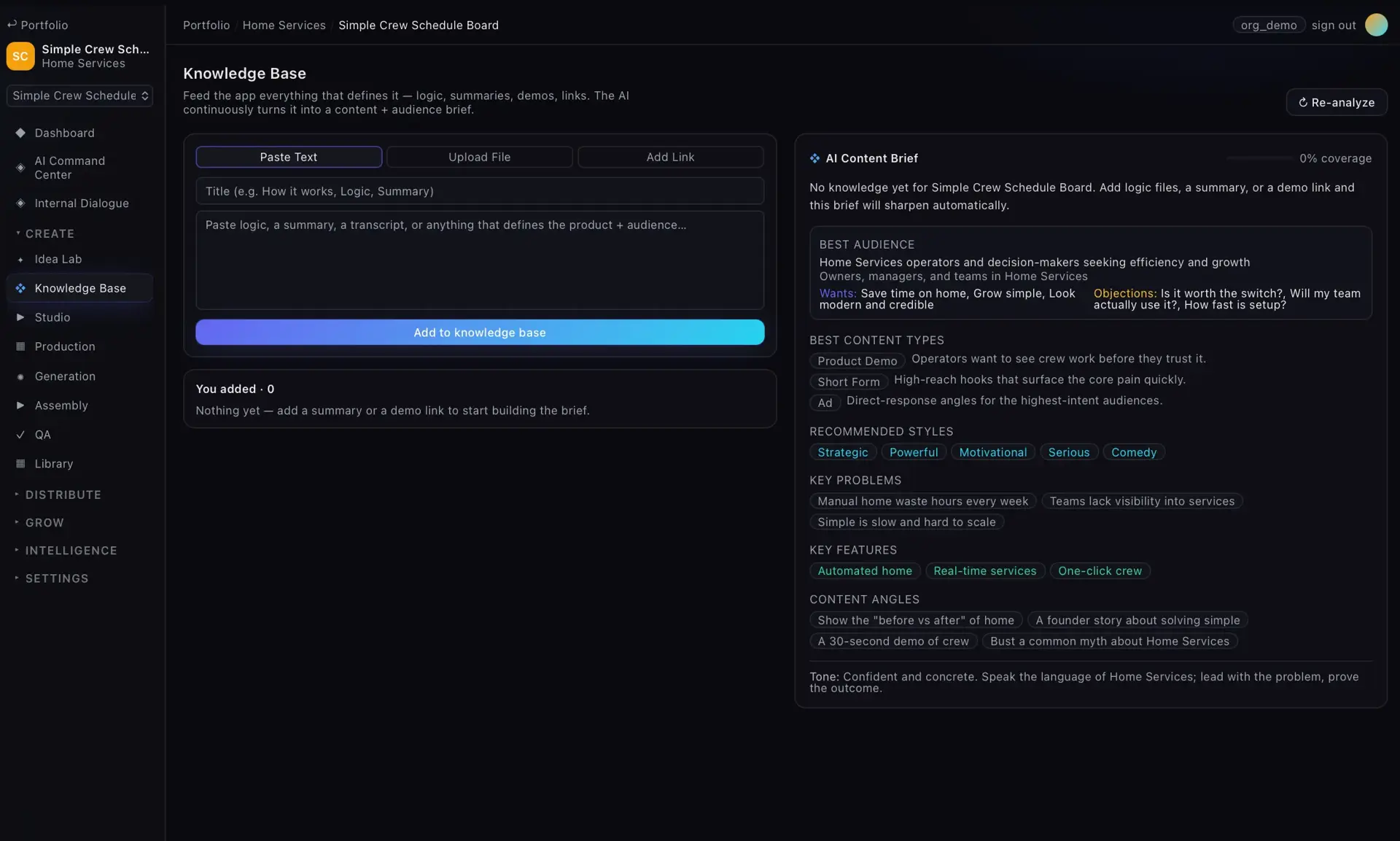
Knowledge Base page with paste text, upload, and add-link inputs on the left and an AI content brief with audience and content types on the right.
Knowledge Base
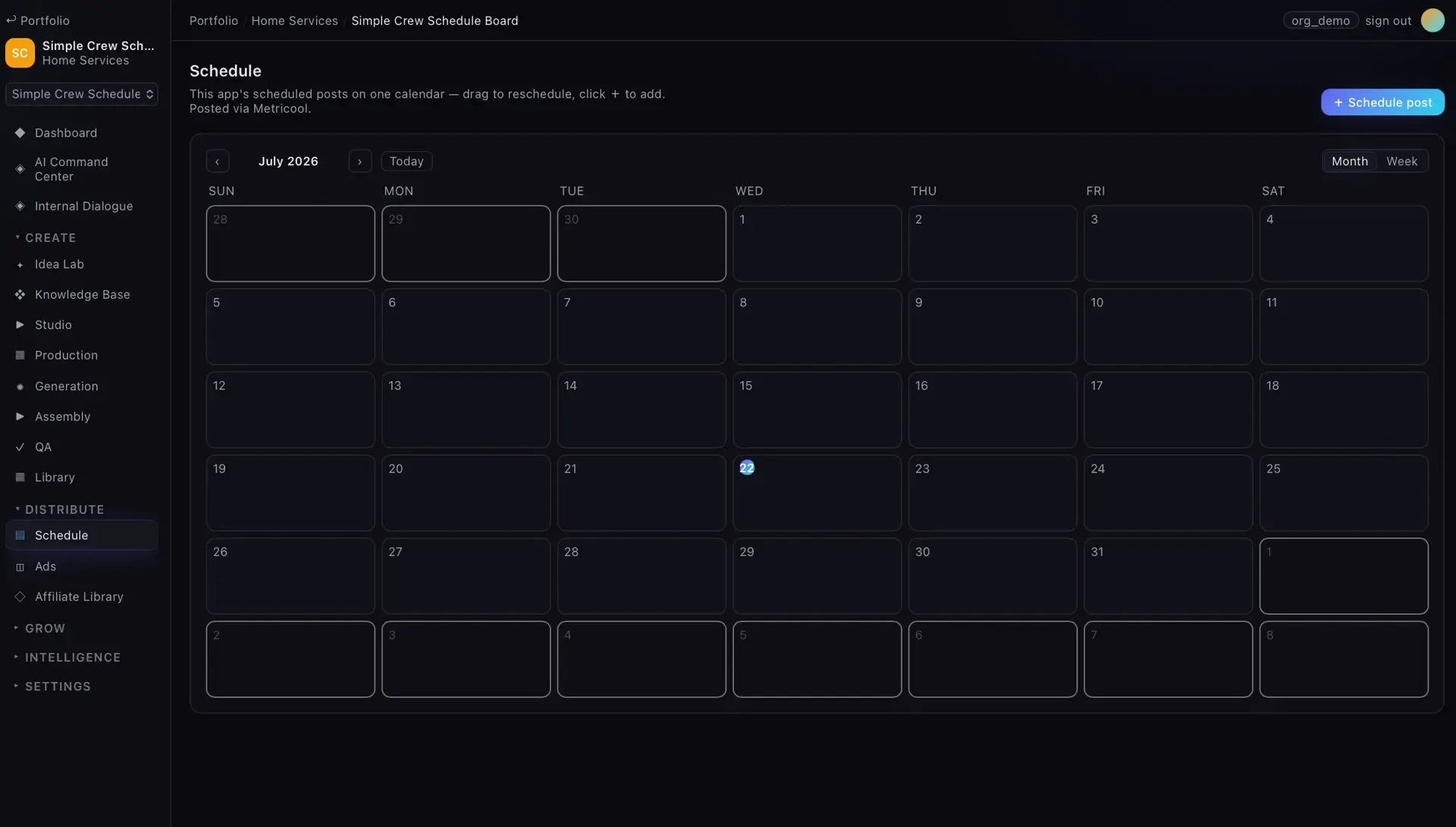
Schedule calendar for July 2026 showing an empty month grid with today (the 22nd) highlighted; posts scheduled via Metricool.
Posting calendar
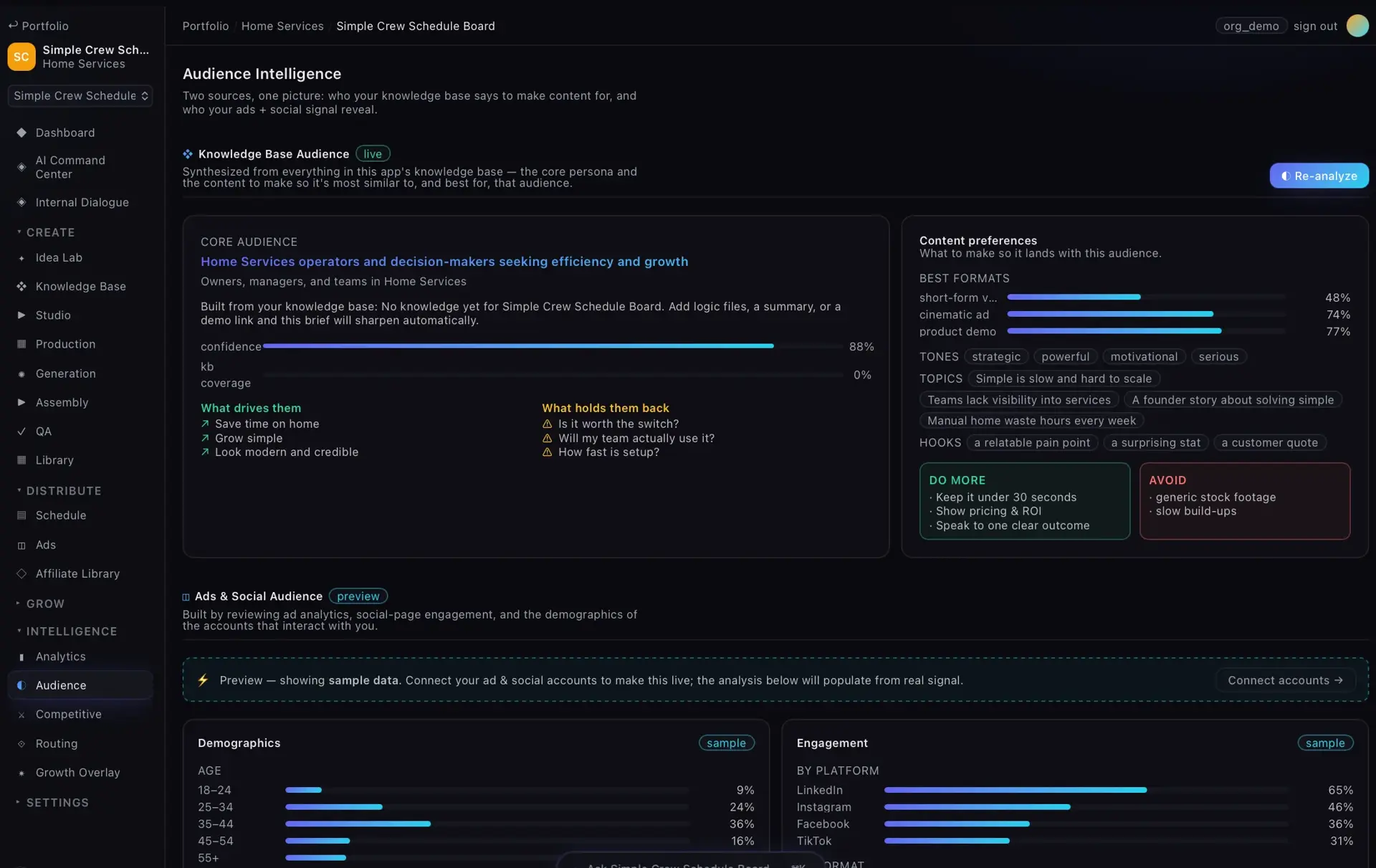
Audience Intelligence showing knowledge-base core audience with confidence bars, content preferences, and sample ads/social demographics.
Audience Intelligence
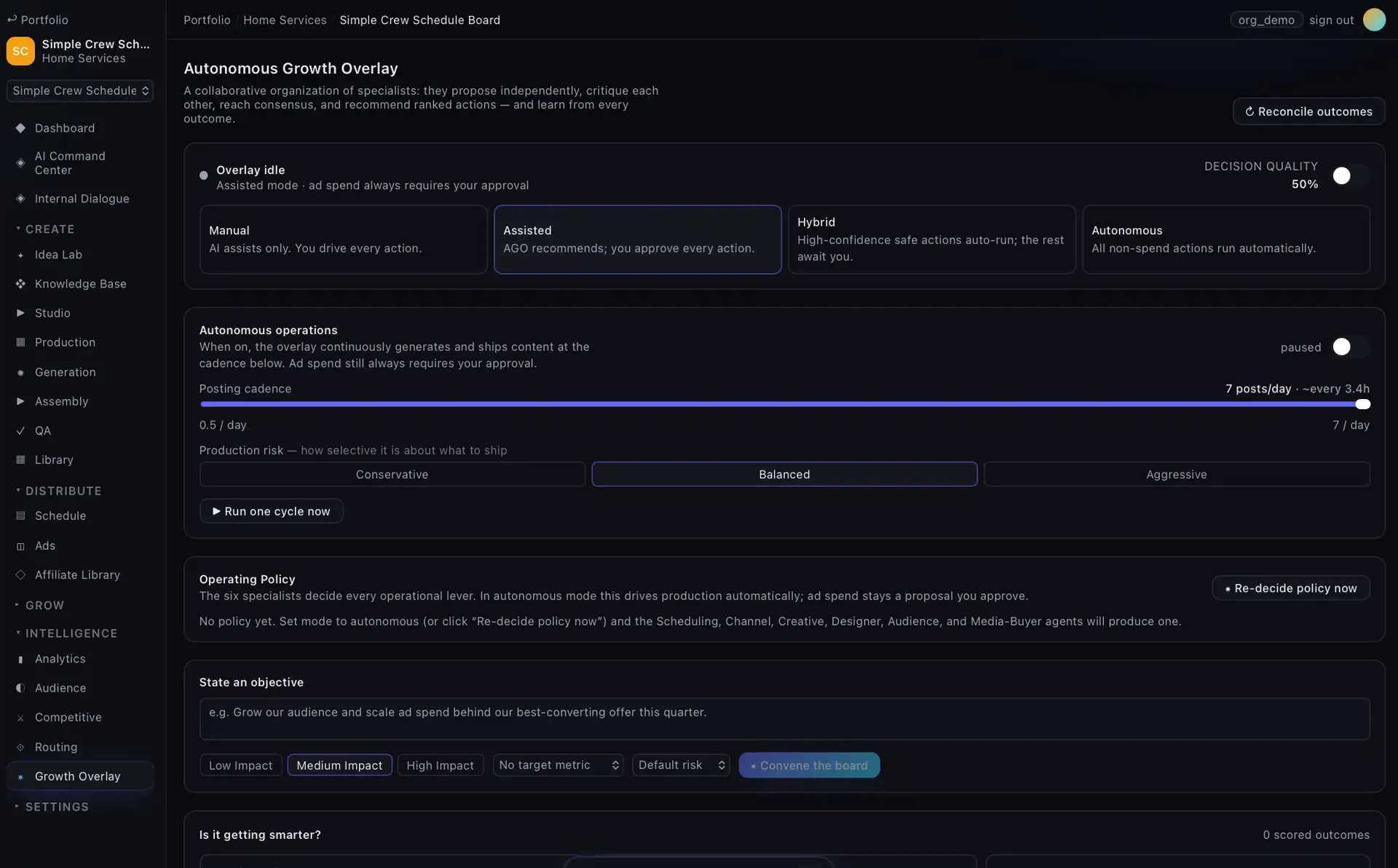
Autonomous Growth Overlay settings: mode selector (manual/assisted/hybrid/autonomous), posting cadence slider, production risk, and objective input.
Autonomous growth overlay
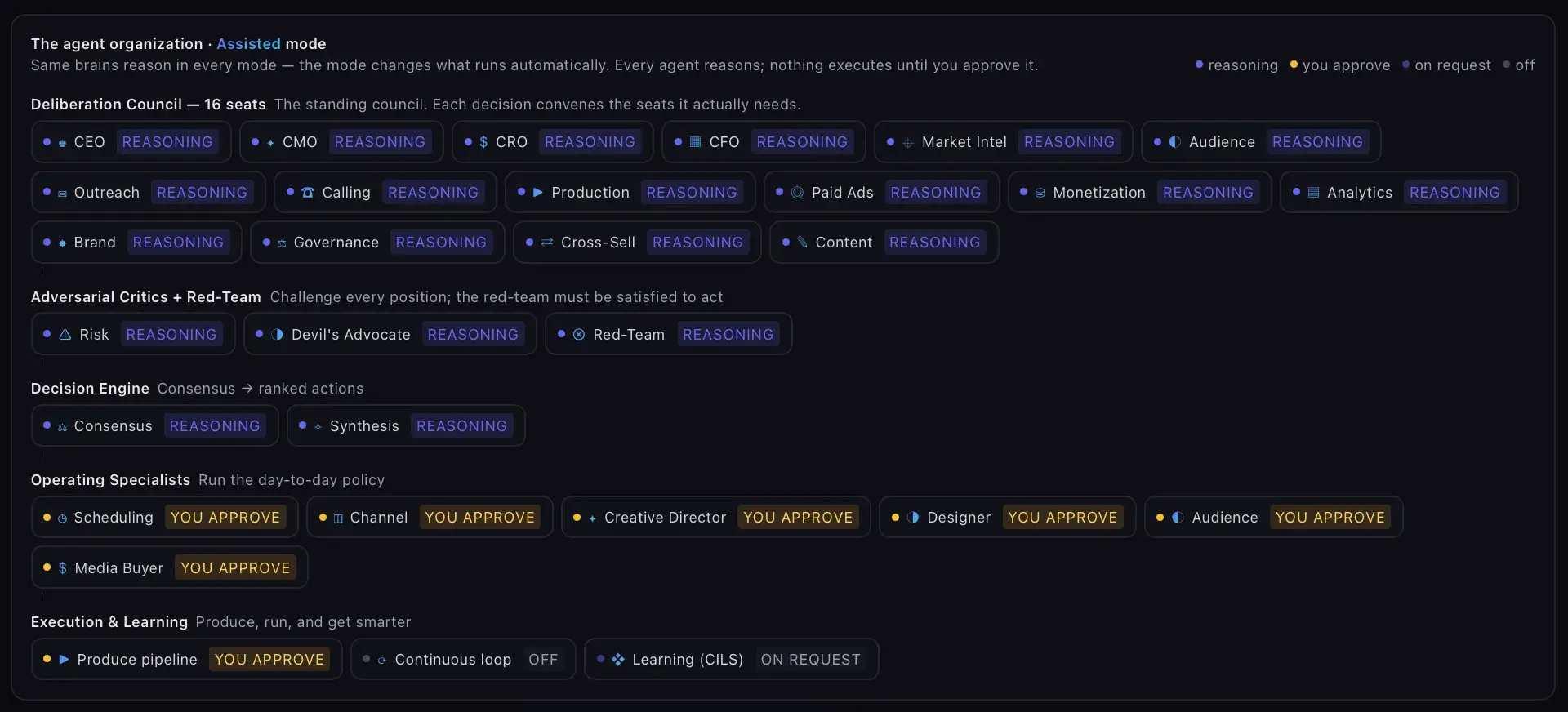
Agent organization diagram in assisted mode: 16-seat deliberation council, adversarial critics, decision engine, and operating specialists with reasoning/approval states.
Agent organization map

How it is built

A pnpm/Turbo monorepo with a Next.js web app and a Fastify API over 40+ independently structured domain services. State lives in PostgreSQL (via the postgres/pglite drivers and Drizzle) with row-level tenant isolation and an append-only event log; a Redis pub/sub bus fans events across instances, a job kernel runs asynchronous pipelines, and S3-compatible object storage holds generated media. AI, media, outreach, and ad providers each sit behind adapters with deterministic offline stubs, and telemetry is exported over OpenTelemetry.

APIs and services

Anthropic
OpenAI
Google Gemini
ElevenLabs
HeyGen
fal.ai
Runway
Luma
Kling
Clerk
AWS S3
Stripe
Metricool
Google Ads
Meta Ads
TikTok Ads
LinkedIn Ads
OpenTelemetry

Classification

Related work

AI Acquisition Hunter

In Development

An AI acquisition-intelligence platform that surfaces and scores off-market acquisition targets from public business signals.

Building something with similar AI Automation, Analytics, Authentication functionality?

Start a project and reference this one — the conversation begins with what you have already seen.

Start a project